Running Head: Results of the RARICO Study
Funding Support: This study was supported by an investigator-initiated grant funded by Theravance and Viatris (formerly Mylan). Study conduct, data collection, and analysis were performed by the study investigator team and independent from the funder.
Date of Acceptance: October 2, 2026 | Published Online Date: October 20, 2026
Abbreviations: AEs=adverse events; ALT=alanine aminotransferase; ARF=acute respiratory failure; AST=aspartate aminotransferase; BMI=body mass index; CO2=carbon dioxide; COPD=chronic obstructive pulmonary disease; COPDE=chronic obstructive pulmonary disease exacerbation; DCI=digital communication interface; DLCO=diffusing capacity of the lung for carbon monoxide; DM=diabetes mellitus; ESRD on HD=end-stage renal disease on hemodialysis; FEV1=forced expiratory volume in 1 second; FiO2=fraction of inspired oxygen; FVC=forced vital capacity; GCS=Glasgow Coma Scale; I:E=inspiratory-to-expiratory ratio; ICS=inhaled corticosteroid; ICU=intensive care unit; LABA=long-acting beta2-agonist; LAMA=long-acting muscarinic antagonist; MDI=metered-dose inhaler; mMRC=modified Medical Research Council; MV=mechanical ventilation; O2=oxygen; OSA=obstructive sleep apnea; PaCO2=partial pressure of carbon dioxide; PaO2=partial pressure of arterial oxygen; PBW=predicted body weight; PEEP=positive end-expiratory pressure; PNA=pneumonia; Ppeak=peak inspiratory pressure; Pres=resistive pressure; RARICO study=Revefenacin in Acute Respiratory Insufficiency in COPD study; Rdyn=dynamic resistance; Rstat=static resistance; RT=respiratory therapist; SABA=short-acting beta2-agonist; SAMA=short-acting muscarinic antagonist; SD=standard deviation; SJN=standard jet nebulizer; STROBE=Strengthening the Reporting of Observational Studies in Epidemiology; TLC=total lung capacity; UCLA=University of California Los Angeles; VMN=vibrating mesh nebulizer
Citation: Barjaktarevic I, Dartt M, Chen S, et al. Comparison of nebulized long-acting muscarinic antagonist revefenacin to ipratropium in COPD patients with acute respiratory failure requiring mechanical ventilation: results of RARICO study. Chronic Obstr Pulm Dis. 2026; 13(6): 513-522. doi: http://doi.org/10.15326/jcopdf.2026.0804
Online Supplemental Material: Read Online Supplemental Material (443KB)
Introduction
Long-acting muscarinic antagonists (LAMA) are a cornerstone of chronic obstructive pulmonary disease (COPD) management. The only currently available Food and Drug Administration-approved once-daily nebulized LAMA is revefenacin, a long-acting bronchodilator indicated for maintenance therapy in stable COPD.1,2 Despite advances in outpatient management, COPD remains a leading cause of hospitalization, accounting for approximately 700,000 admissions annually in the United States, with nearly 20% of patients readmitted within 3 months.3-5 Although a range of inhaled, oral, and injectable therapies are used in the outpatient settings, LAMAs—either as monotherapy or, preferably, in combination with long-acting beta2-agonists (LABAs)—represent a foundational step in the management of progressive disease.6,7 However, during hospitalization, patients are frequently transitioned away from their home regimens and treated predominantly with short-acting bronchodilators, typically delivered via nebulization.8 Unfortunately, since nebulized long-acting bronchodilators remain underutilized in inpatient settings,9 the reliance on short-acting agents alone may contribute to suboptimal disease control and persistently high readmission rates observed in patients with COPD.7
While primarily indicated in the management of stable COPD, revefenacin is the only available nebulized LAMA and may represent a practical and potentially advantageous alternative to short-acting bronchodilators in hospitalized patients. A particularly relevant subgroup includes COPD patients requiring mechanical ventilation (MV), regardless of the underlying cause of acute respiratory failure (ARF). We conducted a prospective, randomized, double-blind pilot trial to evaluate the safety and feasibility of nebulized revefenacin compared with nebulized ipratropium in mechanically ventilated COPD patients with ARF.
Methods
The Revefenacin in Acute Respiratory Insufficiency in COPD (RARICO) study was conducted at the University of California Los Angeles (UCLA) between October 2020 and January 2025 as a pragmatic, single-center, double-blind, prospective randomized controlled trial approved by the institutional review board (IRB#20-0129). Study procedures were designed to ensure transparent reporting in accordance with the Strengthening the Reporting of Observational Studies in Epidemiology (STROBE) guidelines.10
Patients admitted to the medical intensive care units at Ronald Reagan UCLA Medical Center and UCLA Santa Monica Medical Center were prescreened using an electronic medical record dashboard to identify individuals with COPD requiring intubation. Inclusion criteria were age ≥40 years, acute respiratory failure requiring invasive MV, documented COPD based on prior spirometry (forced expiratory volume in 1 second [FEV1] to forced vital capacity [FVC] ratio <70%), smoking history >10 pack years (current or former), and duration of MV <96 hours at enrollment. Exclusion criteria included chronic respiratory failure requiring long-term MV, suspected liver disease, moderate-to-severe acute respiratory distress syndrome (partial pressure of arterial oxygen [PaO2] to fraction of inspired oxygen ratio <150), other significant pulmonary comorbidities, or anticipated extubation within 24 hours of first dosing (Supplemental Table 1 in the online supplement).
Eligible participants were enrolled after written informed consent was obtained from the patient or a legally authorized surrogate. Participants were randomized in a 2:1 ratio to receive revefenacin 175mcg once daily (2.5mL revefenacin plus 0.5mL normal saline followed by three 3mL normal saline placebo doses at 6, 12, and 18 hours to maintain blinding), or ipratropium 500mcg (3mL) every 6 hours. All treatments were administered via a vibrating mesh nebulizer (VMN) (Aerogen™ Solo, Aerogen Global; Galway, Ireland). Short-acting beta2-agonists (SABAs) (albuterol or levalbuterol) were permitted every 4 hours as needed at the discretion of the treating team. Before administration of the first study dose, participants underwent a 6-hour washout from short-acting bronchodilators and a 24-hour washout from long-acting bronchodilators.
Enrolled participants underwent standardized monitoring visits immediately prior to study drug administration and 90–120 minutes postdose to assess peak effect, on study Days 1, 2, 3, and 7. During these visits, patients were required to passively breathe on the ventilator with a Richmond Agitation-Sedation Scale score ≤ -2. Ventilation was standardized using volume-control mode with tidal volume 8mL/kg predicted body weight (PBW), inspiratory flow 50L/min (decelerating waveform), and positive end-expiratory pressure (PEEP) of 5cm H2O.11
If necessary, tidal volume was reduced in 20mL increments to a minimum of 6mL/kg PBW to achieve a plateau pressure ≤25cm H2O (measured via inspiratory pause).12 Airway clearance, including suctioning, was performed as clinically indicated prior to data collection. Subsequent monitoring visits were conducted using the same ventilator settings. Patients were required to meet predefined criteria for ventilator synchrony, including respiratory rate <120% of the set rate, inspiratory-to-expiratory (I:E) ratio ≥1:2.5 to ensure complete exhalation, absence of inspiratory effort on waveform analysis, and expiratory flow consistent with full return to baseline without evidence of dynamic hyperinflation. If dyssynchrony was observed, short-acting sedatives were administered; if needed, ventilator settings were adjusted (I:E ratio 1:2.5–1:4; inspiratory flow 45–75L/min). Once adequate sedation and synchrony were achieved, ventilator data were captured via a connected laptop. All participants were ventilated using a Puritan Bennett™ 980 ventilator (Medtronic; Boulder, Colorado), enabling breath-by-breath assessment of peak inspiratory pressure (Ppeak), plateau pressure, dynamic resistance (Rdyn), static resistance (Rstat), resistive pressure (Pres), and intrinsic PEEP. Predose, peak, and trough bronchodilator effects on respiratory mechanics were compared between the revefenacin and ipratropium groups. Before continuous data acquisition, 3 inspiratory pauses and one expiratory pause were performed. Respiratory mechanics were obtained using a volume-controlled mode with both constant (square) and decelerating (ramp) inspiratory flow waveform for consistent assessment of plateau pressures. Subsequently, 10 minutes of continuous ventilator data were captured, digitally exported, and stored in the study database. Following data collection, baseline ventilator settings were restored, and further ventilator management was left to the discretion of the clinical team.
Baseline demographic data, medical history, including the most recent spirometry, and complete hospitalization records were reviewed. Study treatment was administered for up to 7 days or until discontinuation of invasive MV, whichever occurred first (Supplemental Figure 1 in the online supplement). The primary outcomes of this pilot study were feasibility and safety. Feasibility endpoints included respiratory therapist (RT) time utilization (including time required for rescue SABA administration), total number of rescue SABA doses, and protocol adherence. Safety endpoints included the frequency and total number of adverse events related to study treatments. Exploratory endpoints included changes in respiratory mechanics across the airway and ventilator circuit (Supplemental Table 2 in the online supplement). Additional exploratory efficacy outcomes included arterial blood gas parameters (including partial pressure of carbon dioxide [PaCO2]), ventilator-free days through Day 28, intensive care unit (ICU) length of stay, hospital length of stay, and mortality.
Statistical Analysis
This pilot study was not powered to detect differences in clinical efficacy between revefenacin and ipratropium. Dichotomous outcomes (e.g., in-hospital mortality) were compared using Chi-square or Fisher’s exact tests, as appropriate. Continuous variables (e.g., ventilator-free days) were compared using the Student’s t-test or Wilcoxon rank-sum test, based on data distribution.
Results
Demographic and Clinical Characteristics of the Study Cohort
Of 24 patients randomized, 3 withdrew consent or clinically deteriorated prior to receiving study drug. The remaining 21 patients were included in the analysis, with 12 assigned to revefenacin and 9 to ipratropium. Participants had a mean age of 76.2±11.2 years, a smoking history of 60.4±50.5 pack years, and a mean FEV1 of 56±26% predicted. Most patients’ home regimens included long-acting bronchodilators (95%) and inhaled corticosteroids (81%). Over half were on supplemental home oxygen (57.1%). Comorbidities were prevalent, including chronic heart failure (52.4%) and diabetes mellitus (42.9%). A majority of patients were admitted via the emergency department (66.7%), and the most common etiologies of respiratory failure were pneumonia (43%) and COPD exacerbation (33%). Study duration ranged from 2 to 7 days, with a mean (standard deviation) of 3.0 (2.5) days (Table 1).
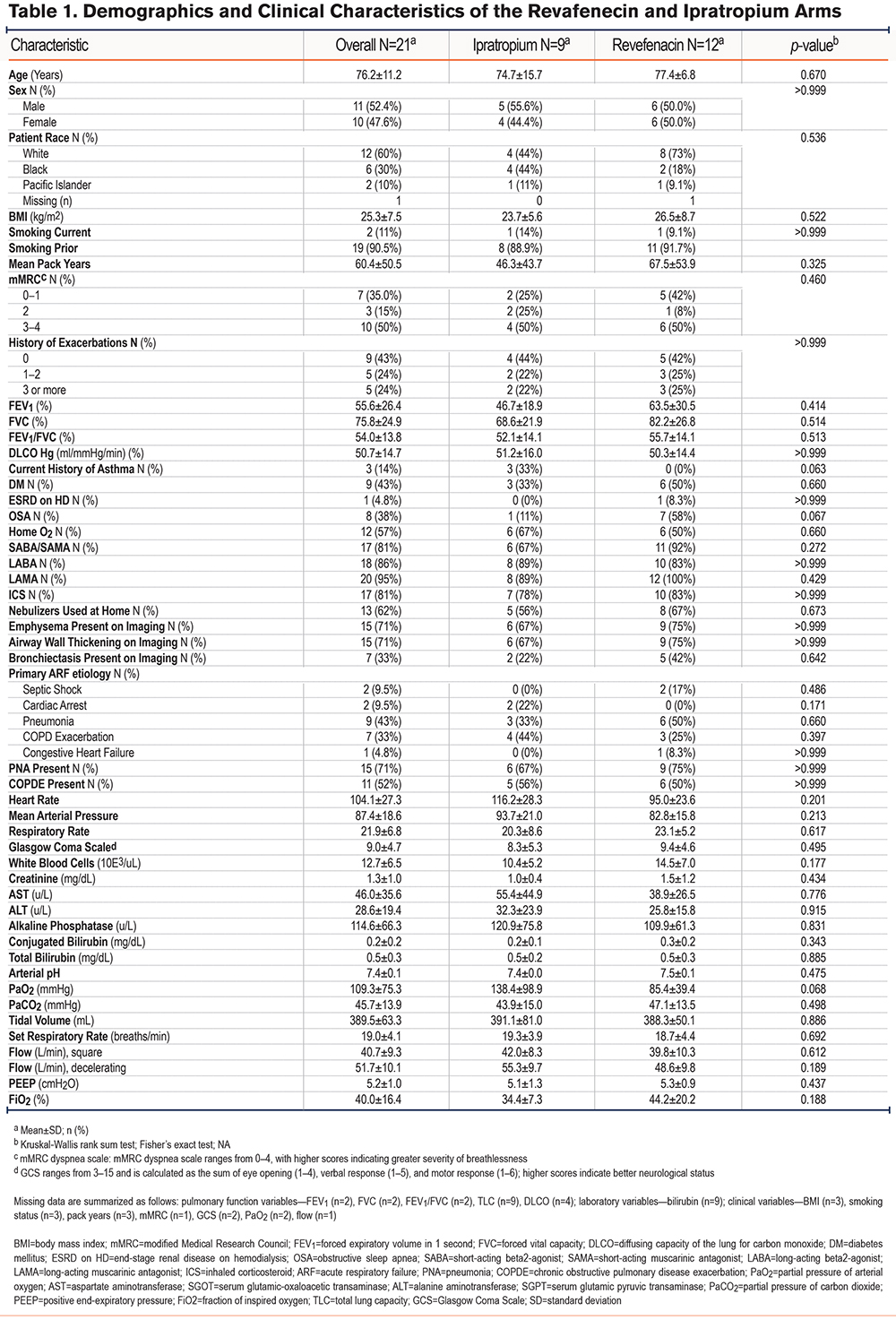
Comparison of Clinical Characteristics Between the Revefenacin and Ipratropium Arms
As presented in Table 1, baseline characteristics were similar between groups. Mean age was 77.4±6.8 versus 74.7±15.7 years in the revefenacin and ipratropium groups, respectively, with 50.0% versus 44.4% female participants. Smoking history was higher in the revefenacin group (67.5±54.0 versus 46.7±43.7 pack years). Pulmonary function was comparable between groups, including postbronchodilator percentage predicted FEV₁ (63.5±30.5% versus 46.7±18.9%), FVC (82.2±26.8% versus 68.6±21.9%), FEV₁/FVC ratio (55.7±14.1% versus 52.1±14.1%), and diffusing capacity of the lung for carbon monoxide (50.3±14.4% versus 51.2±16.0%). Baseline outpatient use of long-acting bronchodilators was similar, including LAMAs (100.0% versus 88.9%), inhaled corticosteroids (83.3% versus 77.8%), and LABAs (83.3% versus 88.9%). A history of asthma was less common in the revefenacin group (0% versus 33.3%), whereas obstructive sleep apnea was more frequent (58.3% versus 11.1%). Other comorbidities, including heart failure and chronic kidney disease, were comparable between groups.
Feasibility of Revefenacin Use in Mechanically Ventilated COPD Patients With Acute Respiratory Failure
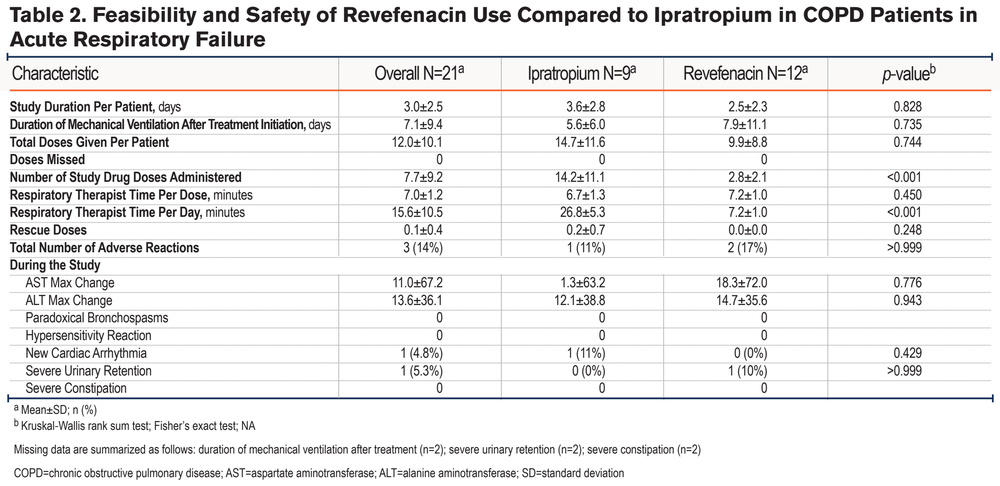
All participants completed the planned study interventions without missed doses prior to discontinuation of MV or completion of the 7-day study period. Following enrollment, patients remained intubated and received revefenacin or ipratropium for a similar duration (2.5±2.3 versus 3.6±2.8 days; P=0.83). Patients in the revefenacin group received fewer total doses of active study drug (2.8±2.1 versus 14.2±11.1; P<0.01) and required significantly less daily nebulization time (7.2±1.0 versus 26.8±5.3 minutes; P<0.01). Use of a rescue SABA was minimal, with no doses in the revefenacin group compared with 2 doses in the ipratropium group.
Safety of Revefenacin Use
Both treatments were generally well tolerated, with no paradoxical bronchospasm or hypersensitivity reactions observed. Three adverse events (AEs) were reported. In the revefenacin group, one patient developed urinary retention, a known class effect of muscarinic antagonists.13 A second event of transaminitis (>3x upper limit of normal) occurred in a patient with abdominal sepsis requiring surgical intervention and was deemed unrelated to study treatment. In the ipratropium group, one episode of transient tachycardia, potentially consistent with a class effect, was observed. No additional AEs or serious adverse events were reported (Table 2).
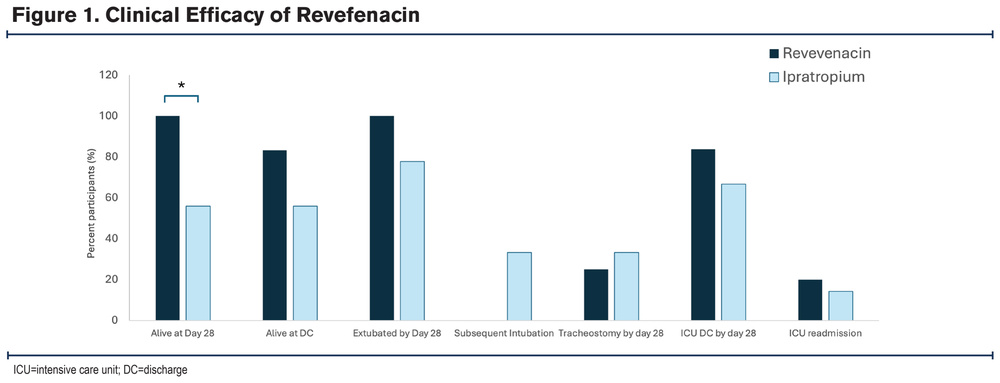
Clinical Efficacy of Revefenacin
All participants in the revefenacin group were alive at Day 28 postintubation (100% versus 55.6% in the ipratropium group; P<0.01), although survival at hospital discharge did not differ between groups. A greater proportion of patients in the revefenacin group were extubated by Day 28 (100% versus 77.8%; P=0.09), with similar durations of mechanical ventilation and ICU stay (Figure 1). There were no between-group differences in changes in changes in partial pressure of arterial oxygen (PaO2) or PaCO2 from predose to peak drug effect.
Respiratory Mechanics and Airway Interaction With Positive-Pressure Ventilation
To compare predose and peak postdrug respiratory mechanics, inspiratory pause maneuvers were used. Plateau pressure minimally changed by +0.3 ± 1.3 versus +0.1 ± 2.5cmH2O in the revefenacin and ipratropium arms, respectively, P=0.96), while Pres change (-0.7 ± 4.8 versus +1.2 ± 1.2, P=0.2) and Ppeak change (-1.0 ± 5.0 versus +1.3 ± 3.1, P=0.34) demonstrated a minimal trend toward improved airway resistance in the revefenacin arm compared to the ipratropium arm, respectively. While Rstat changed similarly in both arms when comparing pre- and postdrug effect, Rdyn was significantly improved in the revefenacin compared to the ipratropium arm (-0.9 ± 2.4 versus 2.6 ± 3.3 cmH2O /L/sec, P<0.01) (Table 3).
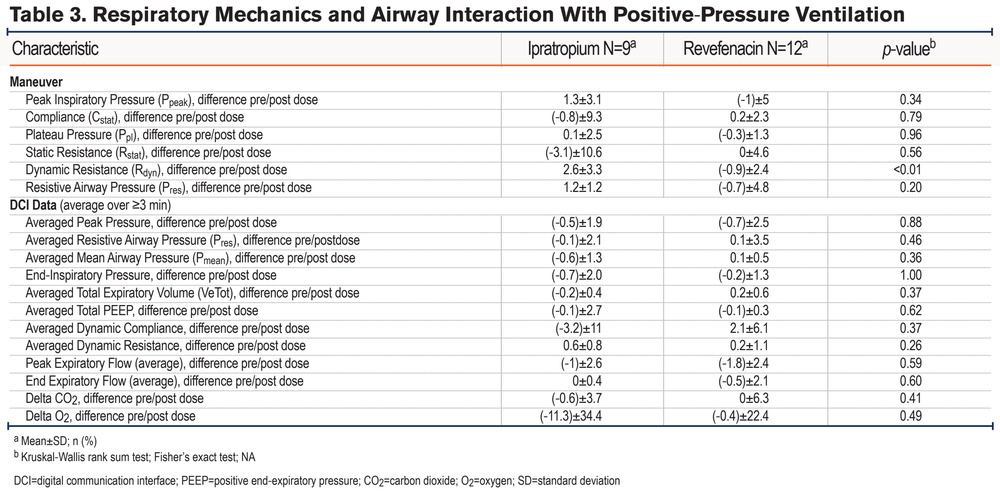
Based on the continuous monitoring of respiratory waveforms (digital communication interface [DCI] data) and ventilatory parameters, no significant differences between the 2 arms were observed, with similar average changes from predrug to post peak drug effect in peak expiratory flow (-1.8 ± 2.4 versus -1 ± 2.6, P=0.6), end expiratory flow rates (-0.5 ±2.1 versus 0 ± 0.4, P=0.6) and total PEEP (-0.1 ± 0.3 versus -0.1 ± 2.7 cmH2O, P=0.6) in the revefenacin versus the ipratropium arm, respectively.
Discussion
The RARICO study was a pragmatic pilot trial designed to evaluate the feasibility and safety of revefenacin, a nebulized LAMA, in mechanically ventilated COPD patients with acute respiratory failure. In this double-blind, randomized controlled trial, revefenacin, compared with ipratropium, was feasible to administer in the critical care setting and was associated with reduced time required for nebulized drug delivery, without significant safety concerns. Trends toward improved clinical outcomes were observed but were not statistically significant.
Revefenacin, approved in 2018 for maintenance treatment of COPD, has been extensively studied in patients with stable moderate-to-severe disease, demonstrating improvements in trough FEV1 with sustained bronchodilation over 24 hours.2 Post hoc analyses suggest greater benefit in patients with more severe airflow limitation.13 A recent prospective study in 60 hospitalized patients with COPD exacerbations compared jet nebulizer–delivered formoterol/revefenacin with albuterol/ipratropium, reporting similar efficacy and safety with fewer administered doses in the long-acting regimen.14 However, critically ill patients requiring noninvasive or invasive mechanical ventilation were excluded. In our study, COPD exacerbation was not an exclusion criterion and approximately one-third of participants had an exacerbation at presentation; however, the primary objective was not to evaluate unstable COPD, but rather to assess the feasibility of revefenacin use in mechanically ventilated patients. To our knowledge, this is the first study to evaluate revefenacin in COPD patients with acute respiratory failure, suggesting it may represent a viable and practical therapeutic option in this setting.
Revefenacin demonstrated expected clinical performance. Consistent with its prolonged duration of action, it required less RT time and no additional rescue SABA use. In the context of increasing emphasis on cost-efficient inpatient care, these findings suggest potential advantages of revefenacin in reducing treatment burden and workflow demands, with potential downstream impact on staff time and resource utilization. In short-term MV patients, nebulized revefenacin may offer practical advantages over inhaler-based delivery (e.g., metered-dose inhalers [MDIs]) by minimizing medication waste and simplifying administration. Although this study was not powered to detect superiority of revefenacin over ipratropium, several findings were encouraging. While higher 28-day survival and extubation rates in the revefenacin group should be interpreted cautiously, clinical outcomes consistently favored revefenacin numerically. The absence of rescue SABA use and the observed improvement in dynamic airway resistance at peak effect further support that once-daily revefenacin provides bronchodilation at least comparable to 4-times-daily ipratropium.
Revefenacin is not recommended in patients with hepatic impairment, as coadministration with OATP1B1 and OATP1B3 inhibitors may increase exposure to its active metabolite; however, there are no data suggesting intrinsic hepatotoxicity.13 Although routine liver function monitoring is not required, transaminases were assessed in this study as an additional safety measure. One episode of transaminitis was observed and was attributed to severe abdominal sepsis rather than study treatment. Overall, there were no meaningful changes in liver enzymes in either group, supporting the hepatic safety of revefenacin in this critically ill population. One patient in the revefenacin group developed urinary retention, a recognized class effect of muscarinic antagonists; however, causality could not be definitively established given the complexity of critical illness. Tachycardia, another known class effect, was not observed in the revefenacin group but occurred in one patient receiving ipratropium.2,14
In addition to evaluating revefenacin as a therapeutic agent in mechanically ventilated COPD patients, this study assessed the feasibility and safety of VMN use within a closed ventilatory circuit. Nebulizers remain the primary modality for inhaled therapy in hospitalized COPD patients and are often perceived as preferable during exacerbations15; however, their use is largely driven by practical considerations rather than evidence of superior efficacy. VMNs, a newer generation of nebulizers, generate aerosol independently of gas flow using a vibrating mesh, producing consistent particle sizes and minimizing drug loss. Integration of a VMN into a closed ventilator circuit may enhance aerosol delivery by minimizing residual volume and reducing circuit-related particle loss, thereby improving distal drug availability despite hygroscopic growth during humidification.
Prior studies and bench models demonstrate that VMNs achieve higher and more consistent lung deposition than standard jet nebulizers (SJNs), particularly under high-flow conditions.16,17 It is, therefore, plausible that delivered doses of revefenacin in this study exceeded those typically achieved with SJNs in outpatient settings. Although enhanced delivery could theoretically increase systemic exposure, available data suggest that higher revefenacin doses remain well tolerated, and improved efficacy may primarily reflect more effective drug distribution.18 Consistent with these observations, no significant safety concerns were identified despite the potential for increased drug delivery; however, the small sample size limits definitive conclusions.
Finally, this study explored the use of ventilator-derived metrics to assess airway physiology and pharmacologic response. Airway disease is traditionally evaluated using pulmonary function testing, while impulse oscillometry may be useful in patients unable to perform forced maneuvers; however, no widely adopted method provides continuous assessment of airway resistance during MV. Inherent properties of obstructed distal airways of COPD patients and changes induced by bronchodilators may be reflected in changes of peak expiratory pressures, dynamic and static airway resistance, resistive pressure, and change in intrinsic PEEP values. This concept is not new. Earlier studies evaluated the efficacy of MDIs in ventilator-supported patients measuring the effect of delivered bronchodilators using airways resistance change.19 Guerin et al randomized 18 mechanically ventilated COPD patients to receive fenoterol-ipratropium via MDI versus nebulizer showing equivalently reduced total respiratory resistance using either of the assessed methods.20 A key limitation of this approach is the typically short duration of MV in COPD. In our cohort, mean duration was 2.5 days, consistent with prior reports (median ~3 days, and ~2 days when COPD exacerbation is the primary etiology).21 Rapid progression to weaning further limits the feasibility of respiratory mechanics assessment, particularly in the presence of spontaneous breathing activity.22
To detect subtle treatment-related changes in airflow and respiratory mechanics, we used 2 complementary approaches: conventional inspiratory and expiratory pause maneuvers and continuous digital recording of ventilator-derived parameters during tidal breathing. The conventional method suggested a favorable effect of revefenacin compared with ipratropium, including improved dynamic resistance and numerical reductions in peak airway and resistive pressures. While the small sample size limits the power to detect differences in either method, the assessment of expiratory flow, particularly from continuous tidal-breathing data, was limited by light sedation and variability in respiratory effort. Nevertheless, in larger cohorts of passively ventilated patients with chronic airway disease, here reported breath-to-breath analysis of airflow and respiratory mechanics using data generated by modern mechanical ventilators represents a promising approach for studying airway disease during mechanical ventilation.
Beyond efficacy and safety, the feasibility of inpatient revefenacin use also depends on its economic implications. Although the acquisition cost of revefenacin exceeds that of generic ipratropium, once-daily dosing could substantially reduce RT time utilization, administration-related supplies, and documentation associated with repeated nebulization. These operational savings could offset the higher acquisition cost and potentially reduce the overall cost of bronchodilator therapy.
Several limitations should be considered. As a pilot feasibility study with a small sample size, this analysis was not powered to compare efficacy between treatment groups or support generalizable conclusions. Randomization was skewed toward more ipratropium due to several drop-out patients whose randomization was not unblinded during the study duration. Clinical differences in the prevalence of asthma, obstructive sleep apnea, or PaO2 levels, even though not statistically significant and while unavoidable in a double-blinded, randomized trial, may have introduced additional bias toward one or another study arm. Exposure to revefenacin was relatively brief, and some patients may not have achieved steady-state drug levels, reflecting the short and variable duration of mechanical ventilation in this population. Although pharmacokinetics was not assessed, peak effects for both agents were evaluated at 90–120 minutes postdose to approximate comparable exposure windows.23 While once-daily dosing may reduce RT time and treatment burden, the absence of increased rescue SABA use suggests that this reduction in treatment frequency did not compromise bronchodilator effectiveness. The study focused on muscarinic antagonists alone, whereas combination therapy with beta-agonists is common in clinical practice; this design allowed for clearer assessment of revefenacin’s safety profile and the use of rescue SABA as an endpoint. Finally, ventilator-derived respiratory mechanics were assessed without standardization of concurrent clinical interventions (e.g., airway clearance, diuretic use) and with less-than-ideal patient–ventilator synchrony, which may limit interpretation of these physiologic measurements.
This study has several notable strengths. To our knowledge, it is the first randomized clinical trial evaluating a nebulized LAMA delivered via VMN in mechanically ventilated COPD patients with ARF. These findings may inform future studies of long-acting bronchodilator therapy in hospitalized patients requiring MV. The use of ventilator-derived parameters to assess airway physiology and pharmacologic response represents a novel approach in this setting and may have value in selected clinical scenarios. Finally, this study supports the feasibility of delivering nebulized therapy within a closed ventilator circuit using VMN technology.
Conclusions
Once-daily revefenacin delivered via VMN was feasible and generally well tolerated in mechanically ventilated patients with COPD and ARF, substantially reducing RT time associated with bronchodilator administration compared with ipratropium. In addition, exploratory respiratory mechanics measurements derived from the mechanical ventilation suggested a potential physiologic benefit. Although this pilot study was not powered for definitive efficacy comparisons, the consistency of physiologic and clinical signals support further investigation of nebulized revefenacnin as a promising therapeutic option in critically ill patients with COPD.
Acknowledgements
Author contributions: IB, DT, RM, SYC, MD, DC, and JB conceived and designed the study. IB, JB, MD, RM, DC, YD, and JV acquired the clinical data. SC, IB and JB analyzed and interpreted the data. IB, DT and JB drafted the manuscript. SC, OE, TY, RGB, and DT critically revised the manuscript for important intellectual content. IB supervised the project and serves as guarantor of the work. All authors approved the final version of the manuscript and agree to be accountable for all aspects of the work.
Other acknowledgements: The authors thank Theravance and Viatris for their support.
Declaration of Interest
IB has received grants from the National Institutes of Health (NIH), the Alpha-1 Foundation, the American Lung Association, the Patient-Centered Outcomes Research Institute, Viatris, Theravance, Aerogen, Fieldstead & Co, and the Johnny Carson Foundation; and reports consulting for Sanofi, Inhibrx, AstraZeneca, GSK, CSL, Theravance, Viatris, Verona Pharma, Merck, Insmed, Takeda, Grifols, Regeneron, Genentech, Liquidia, and Aerogen. MD and DC report research funding from Theravance and consulting fees from Aerogen unrelated to the submitted work. RGB reports personal consulting fees from GSK and Chiesi, unrelated to this work, and grants from the NIH, the VA Office of Research and Development, and the VA Office of Connected Care, unrelated to this work. RGB is an employee of the Veterans Health Administration and the statements in this manuscript do not necessarily reflect the positions of the United States Government. All other authors have nothing to declare.