Running Head: Nurse-Led Breathing Training in COPD
Funding Support: This study was supported by institutional resources from Liyang People’s Hospital. No external funding was received.
Date of Acceptance: September 3, 2026 | Published Online Date: September 30, 2026
Abbreviations: 6MWD=6-minute walk distance; 6MWT=6-minute walk test; AB=abdominal breathing; CAT=COPD Assessment Test; CI=confidence interval; COPD=chronic obstructive pulmonary disease; FEV₁=forced expiratory volume in 1 second; FVC=forced vital capacity; GOLD=Global initiative for chronic Obstructive Lung Disease; ITT=intention-to-treat; mMRC=modified Medical Research Council dyspnea scale; SaO₂=peripheral oxygen saturation; SD=standard deviation; PLB=pursed-lip breathing
Citation: Geng C, Gao Q, Yu J, Huang W. Nurse-led pursed-lip and abdominal breathing training improves pulmonary function and functional exercise performance in patients with chronic obstructive pulmonary disease: a prospective randomized controlled trial. Chronic Obstr Pulm Dis. 2026; 13(6): 463-470. doi: http://doi.org/10.15326/jcopdf.2026.0851
Introduction
Chronic obstructive pulmonary disease (COPD) is a leading cause of morbidity and mortality and is characterized by persistent respiratory symptoms and airflow limitation. Population aging and continued exposure to tobacco smoke, indoor pollutants, and outdoor pollutants are expected to sustain its global burden.1,2 Progressive dyspnea, reduced daily function, and recurrent exacerbations erode health-related quality of life and increase health care use. Small-airway remodeling and dynamic hyperinflation contribute substantially to persistent symptoms in moderate-to-very-severe disease.3
Pulmonary rehabilitation is a cornerstone of nonpharmacologic COPD management.4 Breathing-retraining techniques such as pursed-lip breathing (PLB) and diaphragmatic or abdominal breathing (AB) are intended to lengthen expiration, reduce respiratory rate, and improve breathing mechanics.5 PLB increases expiratory mouth pressure and may help maintain small-airway patency, whereas AB emphasizes diaphragmatic recruitment and reduced accessory-muscle use.6 Short-term physiologic studies have reported favorable changes in tidal breathing and oxygen saturation during PLB,7 but the durability of these effects after structured outpatient training remains less certain.
Translation of breathing retraining into structured nurse-delivered programs remains heterogeneous. Trials differ in duration, supervision, daily dose, and outcome selection, and systematic reviews have called for more consistent randomized evidence.5,8 Nurses have frequent longitudinal contact with COPD outpatients and are well positioned to teach and reinforce behavioral interventions, yet the effect of a standardized nurse-led program has not been well quantified at trial scale.9 Prior studies have also varied in their use of patient-reported outcomes such as the COPD Assessment Test (CAT)10 and field walking outcomes such as the 6-minute walk test (6MWT).11
We conducted a prospective parallel-group randomized controlled trial of a 12-week nurse-led PLB plus AB program in stable outpatients with Global initiative for chronic Obstructive Lung Disease (GOLD)1 stage 2–4 COPD. We hypothesized that, compared with routine care, the program would improve the coprimary outcomes of forced expiratory volume in 1 second (FEV1) and 6MWT at 12 weeks. We also assessed forced vital capacity (FVC), FEV1/FVC, CAT score, resting peripheral oxygen saturation (SaO2), and modified Medical Research Council (mMRC) dyspnea scale grade. The design incorporated concealed allocation, blinded outcome assessment, intention-to-treat analysis, and prespecified control of familywise type 1 error for the coprimary outcomes, and reporting12 follows Consolidated Standards of Reporting Trials (CONSORT) 2025.
Methods
Trial Design and Setting
This single-center, parallel 2-group randomized controlled trial was conducted at Liyang People’s Hospital between January 2024 and March 2025. Recruitment began in January 2024, and final follow-up was completed in March 2025. The protocol was approved by the institutional ethics committee of Liyang People’s Hospital, and all participants provided written informed consent. Patients and members of the public were not involved in the design, conduct, reporting, or dissemination planning of the trial.
Participants
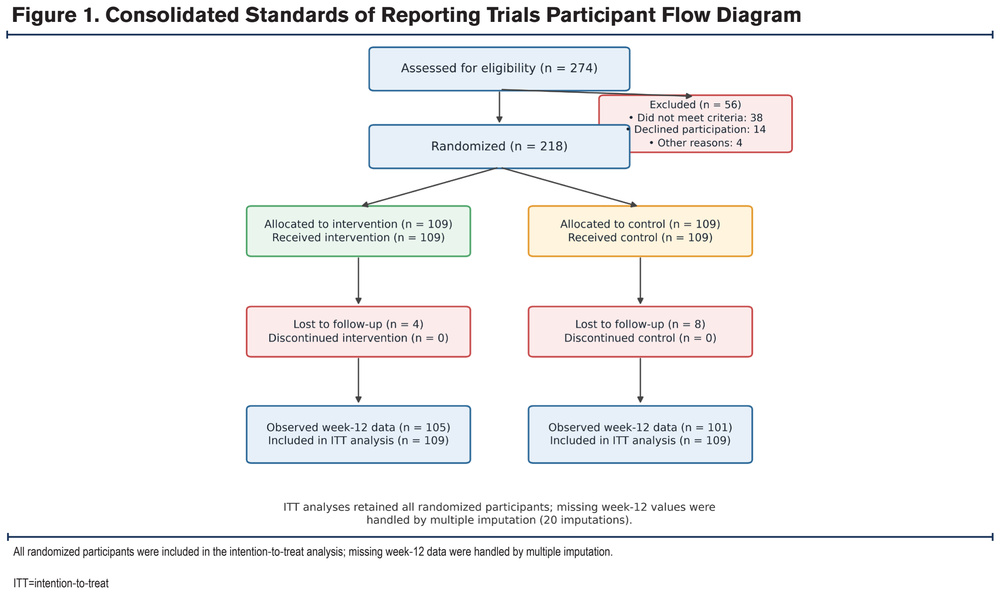
Eligible participants were adults aged 45–85 years with COPD confirmed according to the 2023 GOLD criteria1 (postbronchodilator FEV₁/FVC <0.70) and clinically stable disease for at least 4 weeks. Exclusion criteria were an acute exacerbation within the preceding 4 weeks; coexisting interstitial lung disease, bronchiectasis, active tuberculosis, or lung cancer; New York Heart Association class 3–4 heart failure; inability to perform spirometry or the 6MWT; or cognitive impairment precluding informed consent. Of 274 patients screened, 56 did not enter the trial: 38 did not meet eligibility criteria, 14 declined participation, and 4 were excluded for logistical reasons.
Randomization and Blinding
Eligible participants were allocated 1:1 using a computer-generated sequence with permuted blocks of 4 and 6, stratified by GOLD stage (2 versus 3–4). Sequentially numbered, opaque, sealed envelopes were prepared and opened by a research coordinator independent of recruitment. Recruiting personnel did not have access to the allocation sequence. Outcome assessors performing spirometry and the 6MWT and the statistician conducting the primary analysis were blinded to allocation. Participants and treating nurses could not be masked because of the behavioral nature of the intervention.
Intervention and Comparator
The nurse-led program combined PLB and AB in 30-minute sessions 3 times weekly for 12 weeks. The first 4 sessions were supervised face-to-face by a senior respiratory nurse; subsequent sessions were home-based with weekly telephone reinforcement and a structured paper diary, consistent with prior breathing-training protocols.8 Each session comprised a 5-minute warm-up, 20 minutes of paced PLB plus AB cycles, and a 5-minute cool-down. Participants inhaled through the nose for 2 seconds and exhaled through pursed lips for 4–6 seconds while coordinating abdominal expansion and retraction. No metronome or electronic visual aid was used. During supervised sessions, the nurse standardized pacing by verbal counting; during home sessions, participants followed the same written timing instructions.
Both groups attended scheduled study assessment visits at baseline and week 12. The control group received routine outpatient pulmonary care, including pharmacotherapy review and standard health education, with additional clinical visits as medically indicated; it did not receive structured breathing training or weekly study telephone calls. Thus, nonspecific contact time was not matched between groups. Maintenance inhaler therapy was managed as part of routine care, but bronchodilator class and longitudinal medication changes were not captured with sufficient granularity for regimen-specific analysis.
Outcomes
The coprimary outcomes were 12-week changes in FEV1 (liters) and 6-minute walk distance [6MWD] (meters). Spirometry and the 6-minute walk test were conducted according to European Respiratory Society/American Thoracic Society standards.11 The 6MWT was performed once at baseline and once at week 12 along a 30-meter (m) flat indoor corridor using standardized encouragement; it was treated as a measure of functional exercise performance rather than maximal exercise capacity. Secondary outcomes were FVC, FEV1/FVC, CAT score (range, 0–40; higher scores indicate worse health status),10 resting SaO2 measured by finger pulse oximetry after 10 minutes of seated rest, and mMRC dyspnea grade.13 A 2-point reduction was used as the CAT minimum clinically important difference.14 Because a universally validated minimum clinically important difference for the categorical mMRC scale has not been established, mMRC was analyzed as an ordinal outcome without applying a responder threshold.15 Adverse events were actively elicited at clinic visits and weekly intervention telephone contacts and recorded in a safety log.
Sample Size
The sample-size calculation used an anticipated between-group difference in FEV₁ change of 0.12L, a within-group standard deviation of 0.25L, a 2-sided α of 0.05, and 90% power. This yielded 92 participants per group. Allowing for approximately 15% attrition, the target sample was 218 randomized participants.
Statistical Analysis
Continuous variables were summarized as mean (standard deviation [SD]) or median (interquartile range), and categorical variables as number (percentage). The primary analysis followed the intention-to-treat principle and included all 218 randomized participants. For each continuous outcome, an analysis of covariance model estimated the between-group difference in 12-week change while adjusting for the corresponding baseline value, age, sex, and GOLD stage. Missing values were addressed by fully conditional multiple imputation with 20 imputations, and estimates were pooled using Rubin rules.16
Familywise type 1 error for the 2 coprimary outcomes was controlled at 0.05 with a fixed-sequence procedure specified as FEV₁ followed by 6MWD. FEV₁ was tested first at a 2-sided α of 0.05; only if that null hypothesis was rejected was 6MWD tested confirmatorily at the same α. Had FEV₁ not been significant, the 6MWD result would have been considered exploratory. Secondary outcomes were not adjusted for multiplicity and were interpreted as exploratory, with effect estimates and 95% confidence intervals (CIs) emphasized rather than dichotomous significance. Welch 2-sample t tests of raw change scores were sensitivity analyses. The mMRC distribution shift was evaluated with a Cochran–Mantel–Haenszel test for ordered categories. Standardized effects were expressed as Cohen d.17 Tests were 2-sided, and analyses used Python 3.11 with NumPy, SciPy, pandas, statsmodels, and Matplotlib.
Results
Participant Flow and Baseline Characteristics
Of 274 patients screened, 218 were randomized (109 per group). Four participants in the intervention group and 8 in the control group were lost to follow-up, leaving observed week-12 data for 105 and 101 participants, respectively. All randomized participants were retained in the intention-to-treat analysis with multiple imputation (Figure 1).
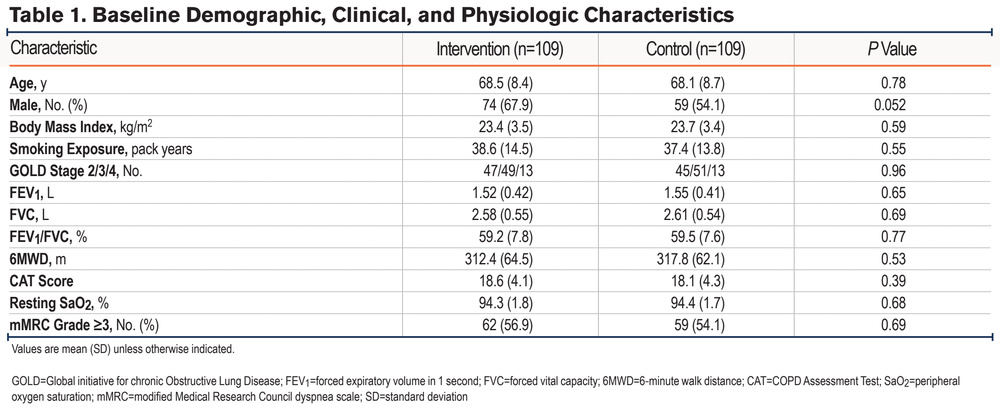
Baseline demographic and clinical characteristics are shown in Table 1. The proportion of male participants was 67.9% in the intervention group and 54.1% in the control group; sex was included as a covariate in the primary model. Age, body mass index, smoking exposure, GOLD stage, baseline spirometric indices, CAT score, 6MWD, resting SaO₂, and mMRC grade were similar between groups.
Pulmonary-Function Outcomes
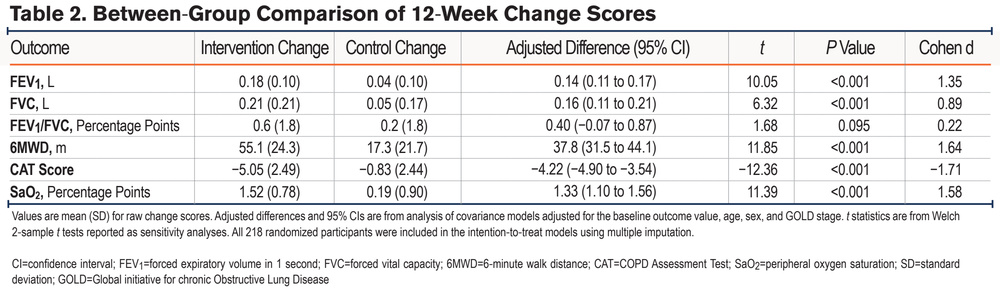
From baseline to week 12, FEV₁ increased by 0.18 (0.10) L in the intervention group and 0.04 (0.10) L in the control group. The adjusted between-group difference was 0.14L (95% CI, 0.11–0.17; P<0.001; Cohen d=1.35). FVC increased by 0.21 (0.21) L and 0.05 (0.17) L, respectively, for an adjusted difference of 0.16L (95% CI, 0.11–0.21; P<0.001; d=0.89). FEV₁/FVC changed by 0.6 (1.8) and 0.2 (1.8) percentage points, respectively; the adjusted difference was 0.40 percentage points (95% CI, −0.07 to 0.87; P=0.095; d=0.22) (Table 2).
Functional Exercise Performance, Symptoms, Oxygenation, Adherence, and Safety
The 6MWD increased by 55.1 (24.3)m in the intervention group and 17.3 (21.7)m in the control group; the adjusted between-group difference was 37.8m (95% CI, 31.5–44.1; P<0.001; d=1.64). CAT score changed by −5.05 (2.49) and −0.83 (2.44) points, respectively, for an adjusted difference of −4.22 points (95% CI, −4.90 to −3.54; P<0.001; d=−1.71). Resting SaO₂ changed by 1.52 (0.78) and 0.19 (0.90) percentage points, respectively; the adjusted difference was 1.33 percentage points (95% CI, 1.10–1.56; P<0.001; d=1.58) (Table 2). Intervention participants completed 87.2% of scheduled sessions. No intervention-related adverse events were reported.
Correlations of Change Scores
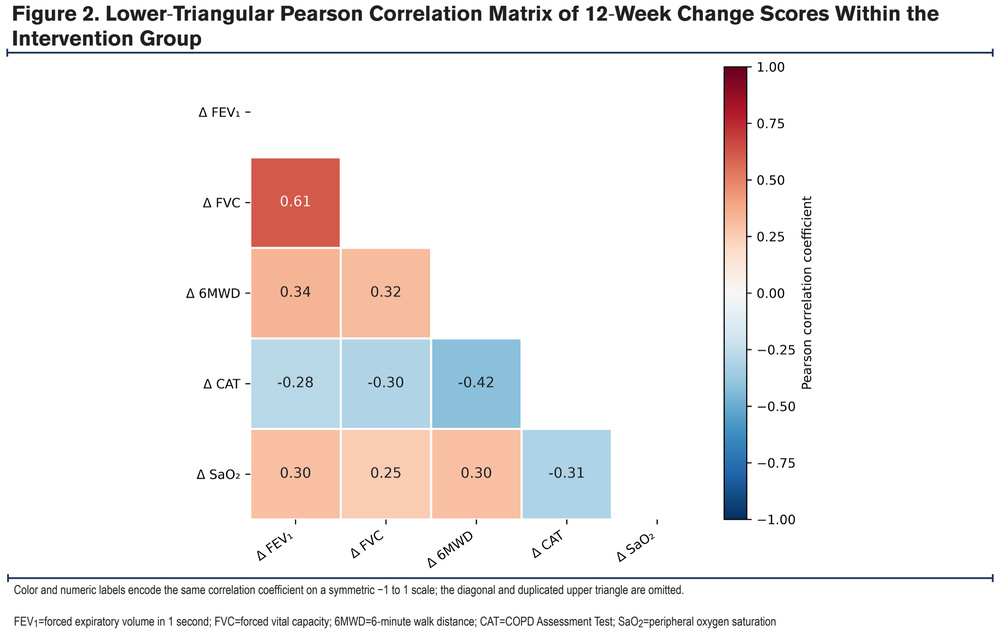
Within the intervention group, FEV1 change correlated with FVC change (Pearson r=0.61) and 6MWD change (r=0.34). CAT change correlated with 6MWD change (r=−0.42) and SaO2 change (r=−0.31). The complete lower-triangular correlation matrix is presented in Figure 2.
Dyspnea Grade
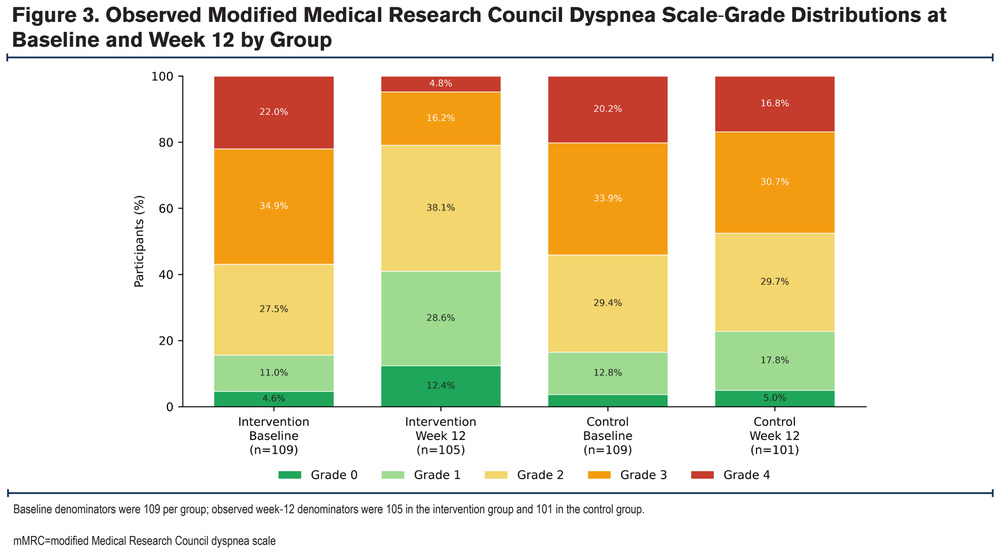
The proportion of participants with an mMRC grade 3 or 4 decreased from 56.9% at baseline to 21.0% at week 12 in the intervention group and from 54.1% to 47.5% in the control group. The between-group difference in the ordered grade shift was significant (Cochran–Mantel–Haenszel χ²=27.4; df=1; P<0.001). Observed grade distributions are shown in Figure 3.
Discussion
In this randomized trial, a 12-week nurse-led PLB plus AB program improved FEV1, FVC, 6MWD, CAT score, and resting SaO2 relative to routine care. The adjusted 6MWD difference of 37.8m exceeded the approximately 30-m threshold commonly used for clinically important change in severe COPD,18 and the adjusted CAT difference exceeded the 2-point threshold.14 The FEV1 difference of 0.14L also exceeded the 0.10-L benchmark commonly used to interpret bronchodilator trials.19 These comparisons describe the magnitude of the observed effects but do not establish long-term clinical benefit.
The spirometric changes require cautious interpretation. Pulmonary rehabilitation and breathing retraining do not consistently improve resting spirometric measures,4,5 although PLB can alter breathing pattern and chest-wall mechanics acutely.6,7 The present trial did not include serial inspiratory-capacity measurements, exercise tidal loops, or cardiopulmonary exercise testing to determine whether dynamic hyperinflation occurred. In addition, detailed longitudinal bronchodilator regimens were not available for analysis; medication changes, therefore, cannot be excluded as a contributor to the spirometric findings. Replication with prespecified medication auditing and mechanistic measurements is needed.
The 6MWT measures functional exercise performance under standardized conditions rather than maximal exercise capacity.11 Because only 1 test was performed at each time point, the estimated change may include a learning component and has less precision than an assessment based on duplicate tests. Random allocation should reduce systematic between-group imbalance in this effect, but it does not eliminate measurement uncertainty. The observed 6MWD improvement should not be interpreted as evidence of improved prognosis because this interventional trial did not measure long-term clinical outcomes.
The correlations among changes in spirometry, 6MWD, CAT score, and SaO2 suggest that responses occurred across several domains, but these within-group analyses were exploratory and do not identify a mechanism. The mean baseline SaO2 was approximately 94% in both groups. Therefore, the 1.33-percentage-point adjusted improvement should not be generalized to patients with normal oxygenation or interpreted as an indication for altered oxygen therapy; no baseline-oxygenation subgroup analysis was prespecified.
The program used 4 face-to-face sessions followed by home practice and weekly telephone reinforcement. This low-resource format may be feasible where comprehensive pulmonary rehabilitation is unavailable.4,9 However, the control group did not receive matched weekly study contact, so attention and behavioral reinforcement may have contributed to patient-reported and performance outcomes. Objective assessment of intervention fidelity was also unavailable during the home phase.
Several limitations should be considered. The single-center setting limits external generalizability. Participants and treating nurses were not masked, creating potential performance bias. Twelve weeks was insufficient to evaluate exacerbations, hospitalizations, or mortality. Patients with GOLD stage 1 disease were not enrolled, and the requirement for clinical stability limits application to frequent exacerbators. The groups differed numerically in sex distribution, although adjusted analyses included sex. Bronchodilator regimens and changes were not characterized in sufficient detail. The 6MWT was not performed in duplicate, and cardiopulmonary exercise testing, inspiratory capacity, arterial blood gases, and serial dynamic-hyperinflation measures were not collected. Finally, home adherence was based on diaries and telephone confirmation rather than an objective sensor or digital log.
The standardized effects were larger than those usually reported for breathing retraining. The observed SD of FEV1 change was smaller than the value assumed for sample-size planning, which increased the standardized effect estimate. Selection of clinically stable participants, structured nurse support, and self-reported adherence may also have produced an efficacy estimate that will not be reproduced in less selected settings. Pragmatic multicenter trials are needed to estimate effectiveness across different clinical environments.
Conclusion
A 12-week nurse-led PLB plus AB program improved spirometric outcomes, functional exercise performance, symptoms, and resting oxygenation in stable outpatients with GOLD stage 2–4 COPD. Confirmation in multicenter trials should include duplicate 6MWTs, prespecified documentation of bronchodilator stability, objective adherence monitoring, and cardiopulmonary exercise testing with serial assessment of inspiratory capacity and dynamic hyperinflation.
Acknowledgments
Author contributions: CG was responsible for the conceptualization of the manuscript. WH acted as supervisor and project administrator. QG and JY were responsible for the investigation. CG provided the formal analysis, while QG was in charge of data curation, and JY responsible for methodology. CG wrote the original drafts, and WH reviewed and edited. All authors reviewed and approved the final manuscript.
Data sharing: Deidentified individual participant data and a data dictionary may be made available by the corresponding author beginning 3 months and ending 5 years after publication to researchers whose methodologically sound proposal is approved by the institutional ethics committee and the study team, for the purposes specified in the approved proposal and subject to a data-use agreement.
Other acknowledgements: The authors thank the participating patients and the respiratory nursing and pulmonary-function laboratory staff of Liyang People’s Hospital.
Declaration of Interest
All authors declare that they have no competing interests.