Running Head: Doxycycline for HIV-Associated COPD and Emphysema
Funding Support: Research reported in this publication was supported by the National Heart, Lung, and Blood Institute and National Center for Advancing Translational Sciences of the National Institutes of Health under awards R34HL117352 and UL1TR002384 (Weill Cornell Medicine Clinical and Translational Science Center). Pfizer Inc (New York, NY) provided doxycycline (Vibramycin®). The content is solely the responsibility of the authors and does not necessarily represent the official views of the National Institutes of Health.
Date of Acceptance: September 3, 2026 | Published Online Date: September 30, 2026
Abbreviations: ANCOVA=analysis of covariance; BAL=bronchoalveolar lavage; CAT=COPD Assessment Test; COPD=chronic obstructive pulmonary disease; CRP=C-reactive protein; CT=computed tomography; DLCO=diffusing capacity for carbon monoxide; FEV1=forced expiratory volume in 1 second; FVC=forced vital capacity; GLI=Global Lung Function Initiative; GOLD=Global initiative for chronic Obstructive Lung Disease; HBsAg=hepatitis B surface antigen; HPLC/MS=high-performance liquid chromatography-mass spectrometry; IFN=interferon; IL=interleukin; IQR=interquartile range; MMP=matrix metalloproteinases; PLWH=people living with HIV; sCD14=soluble CD14; TNF=tumor necrosis factor
Citation: Kaner RJ, O’Beirne SL, Krambrink A, et al. Randomized double-blinded pilot study of doxycycline for HIV-associated COPD and emphysema. Chronic Obstr Pulm Dis. 2026; 13(6): 452-462. doi: http://doi.org/10.15326/jcopdf.2026.0796
Online Supplemental Material: Read Online Supplemental Material (301KB)
Introduction
With the success of antiretroviral therapies in treating people living with HIV (PLWH), comorbidities are assuming increasing importance.1 In a recent systematic review and meta-analysis, the overall prevalence of chronic obstructive pulmonary disease (COPD) in 6 studies of PLWH was estimated to be 10.6%. After adjusting for tobacco use, the risk of COPD remained higher in PLWH compared to people without HIV.2 A subsequent meta-analysis reported associations between HIV and obstructive lung disease, impaired gas exchange, emphysema, and more rapid decline in lung function. Furthermore, in an umbrella review of meta-analyses of observational studies of physical health outcomes, higher COPD prevalence was 1 of 5 of 55 health outcomes that showed suggestive evidence of being associated with HIV. HIV infection may accelerate the onset of emphysema in PLWH,3 and both the prevalence and severity of emphysema were greater in veterans with HIV compared to controls.4 COPD/emphysema contributes to excess mortality, more rapid lung function decline, frailty, poorer functional status, hospitalizations, in-hospital mortality, and greater health care utilization in PLWH.5-13 The Global initiative for chronic Obstructive Lung Disease (GOLD) guidelines recognize HIV as a risk factor for the development of COPD.14
The extracellular matrix, including basement membranes, is the scaffolding that provides the structure of organs, including the lung. Matrix metalloproteinases (MMPs) are a family of enzymes with the capacity to degrade the lung extracellular matrix. Matrix degradation is a key component of emphysema pathogenesis. Degradative enzymes are released by leukocytes, particularly neutrophils and macrophages. The paradigm disease for this process is alpha-1 antitrypsin deficiency leading to unopposed enzymatic activity and increased risk of emphysema. We previously observed that PLWH with early emphysema have increased MMPs (-2, -7, -9, -12; each implicated in emphysema pathogenesis)15 in bronchoalveolar lavage (BAL) fluid samples relative to controls and HIV-negative individuals with emphysema.16 MMPs are, therefore, potential targets for intervention aimed at modifying progression of emphysema specifically in PLWH. In addition to its antimicrobial effects, doxycycline is U.S. Food and Drug Administration-approved as an MMP inhibitor (by binding to the active site in MMP-9) to prevent tissue breakdown in periodontal disease. Based on this background, doxycycline is a candidate drug to test in slowing the progression of emphysema in PLWH.17
There are prior studies evaluating the efficacy of doxycycline in COPD. A retrospective analysis showed that short-term doxycycline added to steroids in the treatment of acute exacerbation of COPD reduced treatment failures in individuals 75 years or older.18 In a small randomized, placebo-controlled trial, a 3-week course of doxycycline did not reduce sputum or systemic markers of inflammation in people with COPD.19 Once daily doxycycline over 12 months did not reduce the overall incidence of acute exacerbations of COPD but did demonstrate benefit in individuals with severe COPD or blood eosinophils < 300/ml.20
As the initial step towards testing the hypothesis that doxycycline will favorably affect the natural history of emphysema in PLWH, and given the paucity of safety and tolerability data in this population, we conducted a proof of concept, randomized, double-blinded placebo-controlled pilot study of doxycycline for COPD/emphysema in PLWH to assess short-term safety and biological effects. We also report BAL fluid concentrations of doxycycline, which have not been systematically studied in humans.
Methods
Design
This was a single center, randomized, placebo-controlled trial of oral doxycycline 100mg twice daily for 24 weeks (NCT01744093). Eligible participants were randomized by the investigational pharmacy in a 2:1 ratio to doxycycline or placebo using permuted blocks of size 3. Lists of treatment assignments were generated by the research pharmacist based on a random numbers table. Only the research pharmacist was aware of treatment assignments until the study was completed and unblinded. The randomization occurred prior to the first research bronchoscopy. Participants were instructed to initiate study drug on the day after the bronchoscopy. The study was approved by the Weill Cornell Medical College Institutional Review Board, and all participants provided written informed consent.
Entry Criteria
Eligible participants had documented HIV infection with current CD4 cell count >200cells/mm3, HIV RNA level <400copies/ml on stable antiretroviral therapy for ≥ 12 weeks. They were current or former smokers (minimum 3 pack-year history)3 and met the GOLD definition for COPD (postbronchodilator forced expiratory volume in 1 second [FEV1] to forced vital capacity [FVC] <0.7)21 grade 1 or 2 and/or had radiographic evidence of emphysema (≥ 5% of voxels <-910 Hounsfield units on chest computed tomography [CT]). We chose the more lenient cutoff for Hounsfield units (versus <-950 Hounsfield units) in order to be inclusive of individuals with early emphysema. We chose a minimum of 3 pack years to maximize inclusivity, based on the concept of increased susceptibility to emphysema in the original description by Diaz et al,3 where the average pack years was 7. Those on therapy for COPD must have been on stable doses for at least 4 weeks. Alanine aminotransferase and aspartate aminotransferase were less than 3x the upper limit of normal. Exclusion criteria included: pulmonary infection, COPD exacerbation, or acute opportunistic infection within 30 days of entry; conditions with increased sedation risk, including but not limited to GOLD Grade 3/4 COPD, requirement for home oxygen, hypercapneic respiratory failure, or poorly controlled hypertension; known allergy/intolerance to doxycycline or any local anesthetic; inability to provide informed consent; pregnant or lactating persons; receipt of any investigational drug within 28 days; end stage renal disease; cirrhosis; international normalized ratio >1.4, platelets <80,000/μL; any condition including active drug or alcohol use or dependence that, in the opinion of the investigator, would interfere with adherence to study requirements or increase the risk of bronchoscopy.
Study Drug
Doxycycline hyclate 100mg (Vibramycin®) capsules were provided by Pfizer Inc and emptied and re-encapsulated to match placebo capsules with lactose filler (Rockwell Compounding Associates, Inc; Rye, New York).
Key Assessments
Eligibility was assessed after a screening visit with baseline laboratory tests, pulmonary function tests, and a high-resolution chest CT (multiple helical CT images acquired at a slice thickness of 1.25mm) at a pre-entry visit unless CT data were available within the preceding 12 months. Percentage of emphysema, defined as the percentage of lung voxels less than −910 Hounsfield units, was quantified by Slicer density mask software.22 Pulmonary function tests were performed according to American Thoracic Society guidelines.23,24 Spirometry pre- and postbronchodilator was repeated at study entry and used as the baseline values. The diffusing capacity for carbon monoxide (DLCO) was adjusted for carboxyHb and percentage predicted calculated using Global Lung Function Initiative (GLI) race-neutral equations.25 Participants underwent bronchoscopy with bronchoalveolar lavage and brushings26 at study entry and week 12. Adverse event assessments including safety laboratory testing were done at weeks 2, 6, 12, 18, and 24 and graded using the National Institutes of Health Division of AIDS Toxicity Grading Table.27 Follow-up spirometry was done at weeks 12 and 24 and DLCO at week 24. The COPD Assessment Test (CAT)28 and smoking questionnaires were administered at entry and weeks 6, 12, and 24. BAL fluid MMP-9 activity was semiquantified by gelatinase assays and normalized to total protein (bicinchoninic acid assay). Doxycycline levels were quantified in BAL fluid and plasma by high-performance liquid chromatography-mass spectrometry. Serum inflammatory markers C-reactive protein (CRP), interleukin (IL)-6, interferon (IFN)-γ, and tumor necrosis factor (TNF)-α were determined by an electrochemiluminescent method (Meso Scale Diagnostics; Rockville, Maryland), and procalcitonin (PCT, BioVendor; Asheville, North Carolina) and soluble CD14 (sCD14) (Abcam; Waltham, Massachusetts) were assayed by enzyme-linked immunosorbent assay in the Clinical Translational Science Center Core Laboratory at Weill Cornell Medicine. Study personnel were blinded to the treatment assignments during the assessment of all clinical and laboratory parameters.
Primary and Secondary Endpoints
The primary endpoint was safety and tolerability of the study drug, as measured by the number of participants with any treatment-related or dose-limiting adverse events. Secondary outcomes included: levels of MMP-9 activity in BAL fluid before and after study drug administration; change in FEV1, FEV1/FVC, and DLCO; change in respiratory symptoms by CAT; change in serum inflammatory markers; change in BAL absolute cell number; change in BAL fluid MMP-9 activity; and incidence of acute exacerbations of COPD.
Statistical Analysis
The study was powered on an expected rate of grade 2 or higher toxicity of 20%–30%. An overall sample size of 30 (20 doxycycline recipients) provided approximately 80% power (one-sided alpha=0.05) to detect a true proportion of 20% (grade 2 or higher toxicity) while rejecting the null hypothesis of 45.5% or higher (in other words, ruling out the possibility of the event rate being any higher than 45.5%).
Secondary Analyses
The change in continuous outcomes was compared between the doxycycline and placebo arms using 2-sample independent t-tests. Nonparametric Wilcoxon rank sum tests were used when normality assumptions were not met. Given the potential for imbalance in baseline values, analysis of covariance (ANCOVA) was also utilized, adjusting for baseline values as a covariate.
The difference in MMP9 (defined as week 12 MMP9 × 1000/protein minus week zero MMP9 × 1000/protein) was also dichotomized as an increase versus decrease and the association with treatment was explored using Fisher’s exact test.
Among those in the doxycycline arm, relationships between serum doxycycline levels and each of the inflammatory markers (CRP, IFN-g, IL-6, TNF, sCD14) at Week 24 were examined using scatterplots. Due to non-normal data, Spearman rho was used to measure the monotonic relationship between drug concentration at week 24 and each inflammatory marker. The relationship between the change in cell differentials (neutrophils, lymphocytes, and eosinophils) from baseline to week 12 and the week 12 doxycycline concentration levels were explored in similar fashion.
Data are expressed as mean ± standard deviation or median (Q1, Q3). Mean differences between treatment groups are reported as mean values of those in the doxycycline arm minus the mean of those in the placebo arm. Data were analyzed with SAS version 9.4 (SAS Institute; Cary, North Carolina). Due to the exploratory nature of many of the endpoints, p-values were not adjusted for multiple comparisons.
Results
Participant Disposition
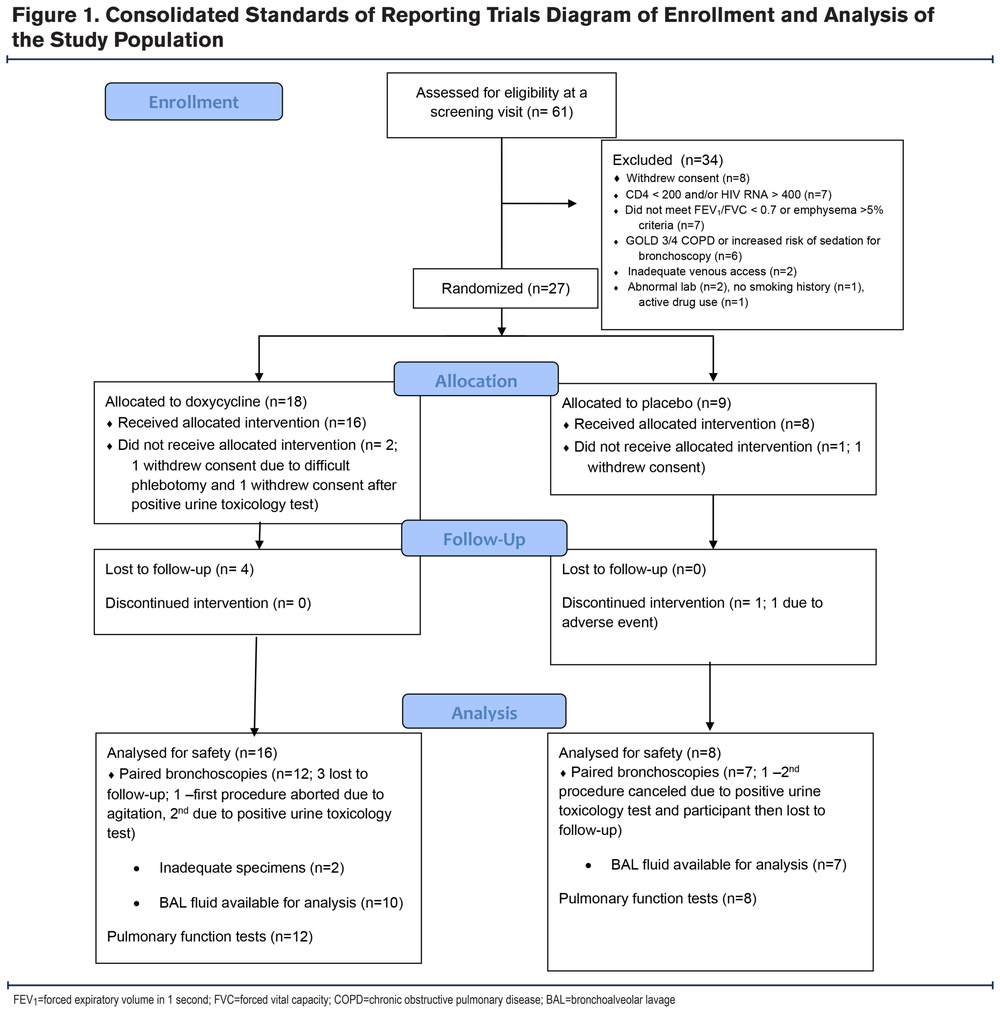
We screened 61 and enrolled 27 participants of a planned 30 prior to closing due to slow accrual. The first and last participants were randomized on February 5, 2015 and February 17, 2017, respectively. Figure 1 summarizes the disposition of participants. Two participants in the doxycycline arm and one in the placebo arm withdrew consent prior to the baseline bronchoscopy and did not initiate the study drug. Paired BAL fluid samples from baseline and week 12 were available on 10 participants in the doxycycline arm and 7 in the placebo arm.
Characteristics
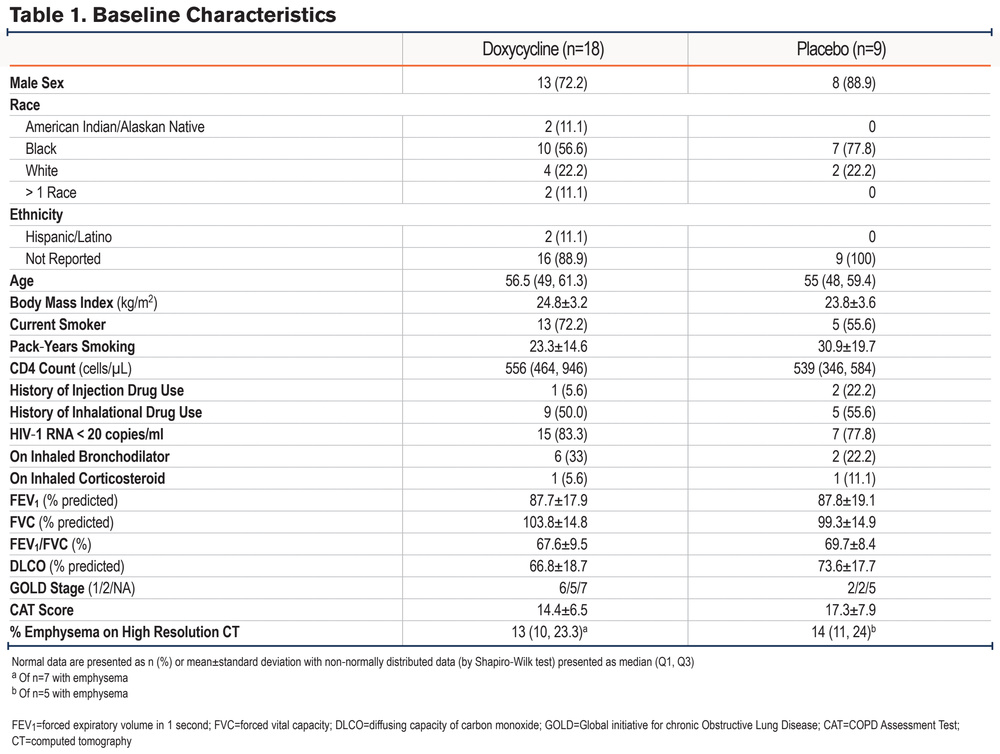
Table 1 summarizes the baseline characteristics of the study participants. The majority of participants were male, African American, and current smokers with well-controlled HIV infection. Twelve of 27 (44%) with available data were hepatitis C virus seropositive. Two of 27 (7%) were hepatitis B surface antigen (HBsAg) positive, one of whom had documented Hepatitis B virus viremia. An additional participant had an indeterminant HbsAg result. A total of 30% were taking inhaled bronchodilators and 7.4% were on inhaled corticosteroids. Twelve participants had protocol-defined emphysema (≥ 5% of voxels < -910 Hounsfield units). Of those with emphysema, percentage of emphysema was similar in the 2 arms: 13% (10, 23) in the doxycycline arm and 14% (11, 24) in the placebo arm.
Safety and Tolerability
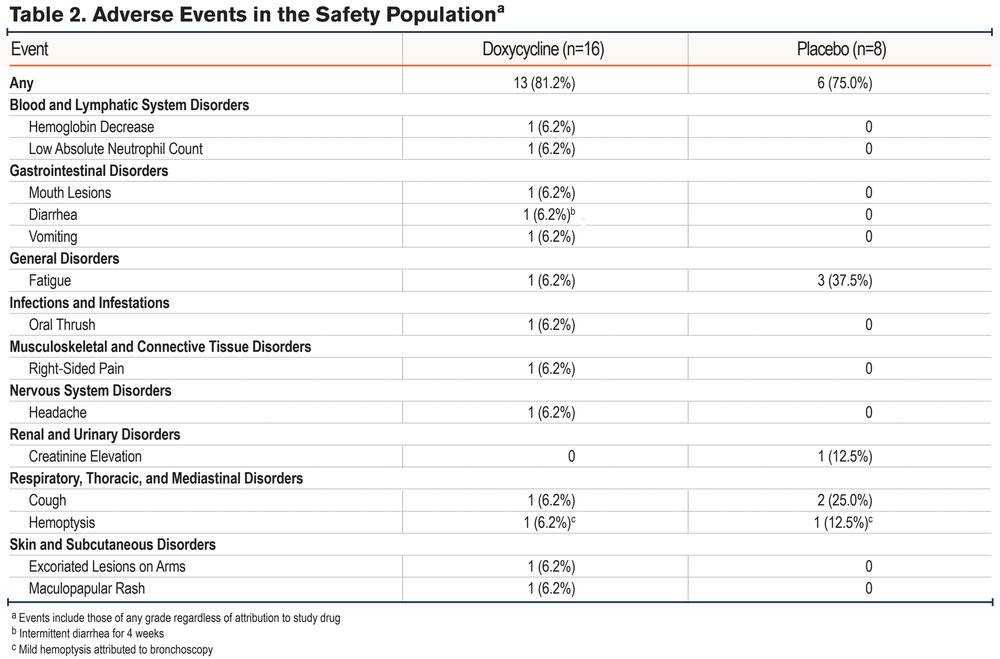
There were no serious or treatment-limiting adverse events. One participant in the placebo arm had a mild reversible creatinine elevation. Table 2 lists the adverse events by study arm. Adverse events were not concentrated in a single category and were mild in intensity.
There were no significant changes in COPD symptoms as assessed by the CAT (data not shown). No COPD acute exacerbations were observed during the study.
Pulmonary Function
There were a total of 22 individuals (13 doxycycline and 9 placebo) with FEV1, FVC, and FEV1/FVC measurements at both weeks zero and 12, and 19 individuals (11 doxycycline and 8 placebo) at both weeks zero and 24. Change from week zero was defined as week 12/24 measurements minus week zero. Supplemental Figures 1–3 in the online supplement show the distributions of FEV1, FVC, and FEV1/FVC, respectively, at baseline, week 12, and week 24. There were no significant differences in the change in any of the pulmonary measures between the doxycycline and placebo arms at either week 12 or week 24, after adjusting for baseline values (p>0.14, ANCOVA).
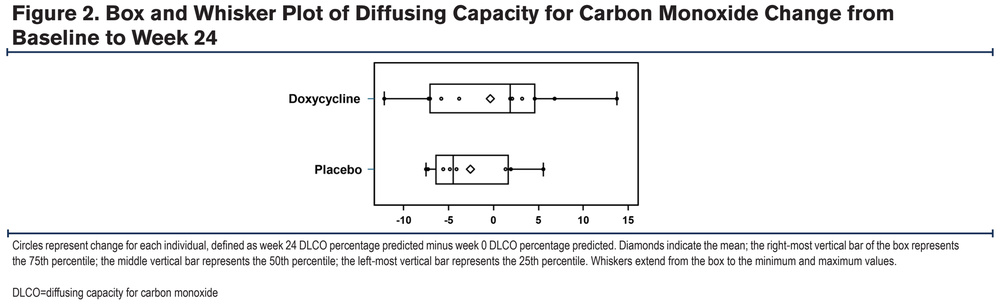
There were a total of 19 participants (11 doxycycline and 8 placebo) with DLCO measurements at both weeks zero and 24. The change from week zero was defined as week 24 percentage predicted DLCO minus week zero percentage predicted DLCO. There was a numerically larger mean decrease in percentage predicted DLCO from week zero to week 24 in the placebo group compared to the doxycycline group (-2.6 versus -0.4, Figure 2), although this difference between treatment groups was not statistically significant after adjusting for baseline DLCO (-0.094; 95% confidence interval =-5.59 to 5.41; p=0.972; ANCOVA).
Doxycycline Levels
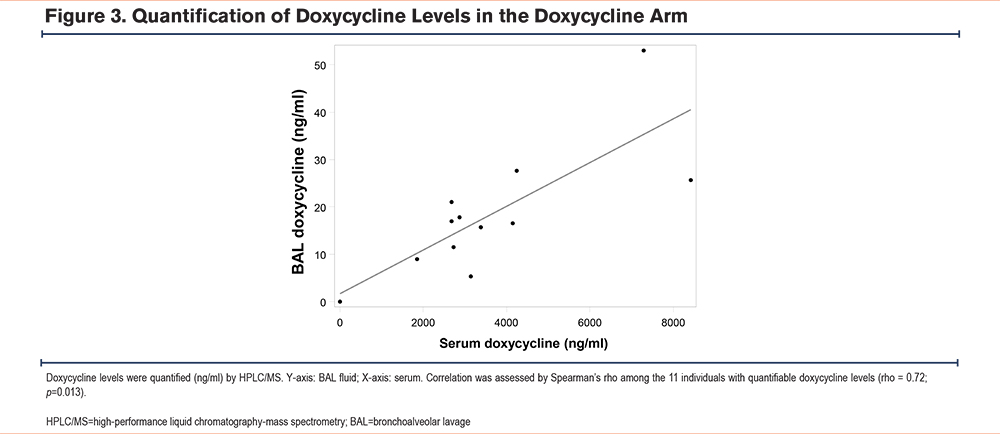
Doxycycline levels (ng/ml) were quantifiable in serum (3950±2062) and BAL fluid (20.0±12.8) in 11 of the 12 individuals with measurable levels assigned to the doxycycline arm at week 12 (Figure 3). Serum and BAL concentrations were closely correlated (Spearman’s rho=0.72; p=0.013).
Effects on Bronchoalveolar Lavage Cell Differentials
There were a total of 20 participants (12 doxycycline and 8 placebo) with absolute cell differentials normalized to BAL fluid at both week zero and week 12; change was defined as week 12 values minus week zero values. There were no statistically significant differences in the change from baseline to week 12 for BAL fluid neutrophils, eosinophils, or lymphocytes between the doxycycline and placebo arms (p>0.27, ANCOVA, Supplemental Figures 4, 5, and 6 in the online supplement). Higher BAL concentrations of doxycycline were associated with larger decreases in lymphocytes (Spearman’s rho= -0.63, p=0.028, Supplemental Figure 7 in the online supplement) and eosinophils (Spearman’s rho=-0.58, p=0.050, Supplemental Figure 8 in the online supplement).
Effects on Matrix Metalloproteinases
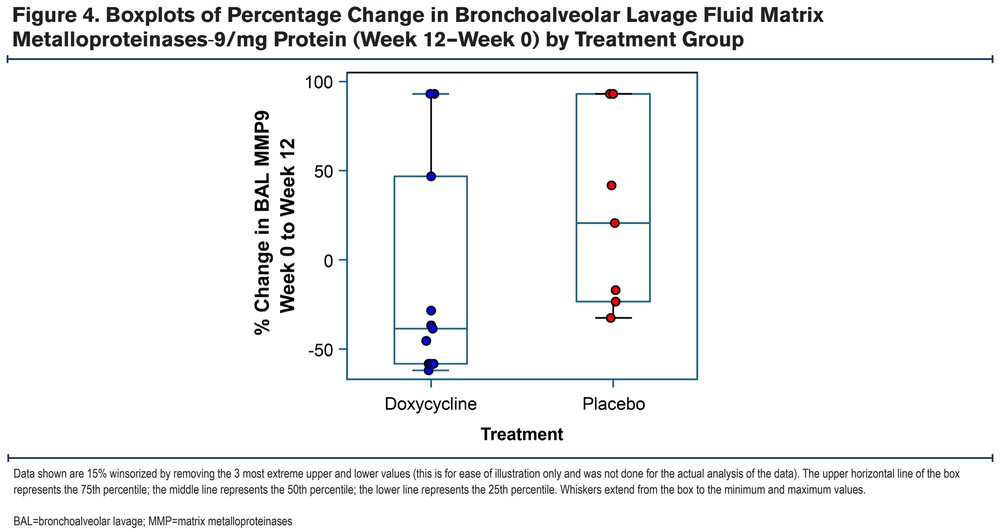
There were 18 total participants (11 doxycycline and 7 placebo) with MMP9 measurements at both week zero and week 12. Among participants with paired bronchoscopy data, a higher proportion of participants in the doxycycline arm had decreases in MMP-9 activity in BAL fluid at week 12 versus baseline (8 of 11 participants on doxycycline versus 3 of 7 participants on placebo (p=0.22, Fisher’s exact test). The median percentage change in MMP-9 activity compared to baseline (ng/mg protein) was -38.4 (interquartile range [IQR]: -61.8; 46.7) for the doxycycline arm and +20.9 (IQR: -23.1; 93.2; p= 0.09, Wilcoxon rank sum test) for the placebo arm (Figure 4).
Cytokines/Inflammatory Markers
There were no significant monotonic relationships between serum levels of doxycycline and any of the inflammatory markers, CRP, IL-6, IFN-g, TNF-a, and sCD14 at week 24 (p>.44, Spearman’s rho, Supplemental Figures 9–13 in the online supplement).
Discussion
In this small pilot study of PLWH with COPD and/or emphysema and tobacco smoke exposure, doxycycline at full treatment doses of 100mg orally bid was safe and well-tolerated over 24 weeks. It is interesting to note that the participants had significant respiratory symptoms (CAT scores 14–17), but only 30% were using inhaled bronchodilators at study entry. Of note, symptom burden due to COPD is higher in PLWH.29 This is concordant with our anecdotal experience of undertreatment of COPD in PLWH. While the study was not powered to detect physiologic or biomarker endpoints, there was relative stabilization of the DLCO from baseline to week 24 in the doxycycline arm, although this was not statistically significant. Quantitative changes in emphysema were not assessed, as we opted not to repeat the CT scan at 24 weeks given the expected slow rate of progression of emphysema in this relatively short time frame.30
The doxycycline drug concentrations observed at week 12 indicate good adherence to the protocol. The levels also suggest robust drug concentrations in both serum and epithelial lining fluid, allowing for the ~50-fold dilution of epithelial lining fluid by infused saline in the BAL technique.26 This study adds to our understanding of lung penetration of doxycycline as assessed by BAL fluid concentrations, which have not previously been reported in humans. Prior human data are limited to sputum/plasma concentration ratios in people with cystic fibrosis dosed with doxycycline, which suggested moderate lung penetration.31 The BAL fluid concentrations of doxycycline are relevant to the site of action of destruction of alveolar walls in emphysema. These alveolar drug levels also comport with the proven clinical efficacy of doxycycline in successfully treating mild to moderate community-acquired pneumonia.32
Interestingly, there was a statistically significant association of BAL doxycycline levels with reduction of BAL fluid lymphocytes, which have been implicated in the pathogenesis of emphysema,18 particularly in PLWH.3 There was also a trend toward reduction in BAL MMP-9 activity levels in the doxycycline arm. These observations are evidence of potentially favorable biologic effects of doxycycline in the alveolar space in PLWH.
There are significant limitations to our study. As a pilot study, it was not adequately powered to identify infrequent side effects, demonstrate significant effects on diffusing capacity, BAL fluid cell differentials, or MMP-9 activity. Furthermore, we had a significant amount of missing data from the bronchoscopies due to premature discontinuations from the study. The duration of study drug administration was likely too short to observe any potential effects on radiographic emphysema progression. As a single center study, the results may not be generalizable. While doxycycline was well tolerated, we did not assess for effects on the microbiota and for the acquisition of tetracycline resistance due to budgetary constraints. Despite these limitations, our results support feasibility and proof of concept for a phase 2 randomized, double-blind placebo-controlled trial of doxycycline to evaluate its ability to slow emphysema progression over 72 weeks in PLWH (NCT05382208).
Acknowledgments
Author contributions: All authors made substantial contributions to the conception or design of the work; or the acquisition, analysis, or interpretation of data for the work. HSY performed HPLC/MS. Y-SZ contributed to the inflammatory biomarker detection. AK and CS were responsible for the statistical analysis. RJK, AK, SLO, CS, HSY, Y-SZ, RGC, and MJG drafted the work or reviewed it critically for important intellectual content. All authors gave their final approval of the version to be published.
Other acknowledgements: The authors acknowledge the dedicated work of Ms. Sandra Hyde in facilitating all aspects of participant scheduling and interactions during the entire study. The authors thank N. Mohamed for editorial assistance and Pfizer, Inc for supplying doxycycline.
Declaration of Interest
RJK has received grant support from the National Institutes of Health (NIH) and doxycycline from Pfizer for this study; fees from Avalyn, Pliant, and PureTech for data safety monitoring boards; funds from Glaxo and Pfizer for Endpoint Adjudication and from Amgen, AstraZeneca, Boehringer Ingelheim, Liquidia, Verona, and United Therapeutics for consulting; royalties from UpToDate and editorial assistance from Boehringer Ingelheim and Genentech. SLO received honoraria from Astra Zeneca and Sanofi. RGC owns shares in Adverum Biotechnologies, ENYX Therapeutics LLC, Jannu Therapeutics, LEXEO Therapeutics, Inc, REGENX Bio, Inc, and XyloCor Therapeutics and received fees from Passage Bio, Inc, for consulting. MJG received grant support from the NIH and doxycycline from Pfizer for this study and royalties from UpToDate. AK, CS, HSY, and Y-SZ have no disclosures.