Running Head: Multimorbidity and Acute-Care Use
Funding Support: No external funding supported this work.
Date of Acceptance: September 4, 2026 | Published Online Date: September 30, 2026
Abbreviations: CCI=Charlson Comorbidity Index; COPD=chronic obstructive pulmonary disease; FEV₁=forced expiratory volume in 1 second; ICU=intensive care unit; IQR=interquartile range; SD=standard deviation
Citation: Romem A, Romem A. Multimorbidity and acute-care use among older decedents with advanced chronic obstructive pulmonary disease: a retrospective population-based cohort study. Chronic Obstr Pulm Dis. 2026; 13(6): 471-478. doi: http://doi.org/10.15326/jcopdf.2026.0807
Introduction
Chronic obstructive pulmonary disease (COPD) is a progressive, life-limiting illness characterized by persistent respiratory symptoms, recurrent exacerbations, functional decline, and high mortality.1,2 In advanced stages, patients often experience severe breathlessness, fatigue, anxiety, repeated emergency presentations, and frequent hospitalization, especially near the end of life.3,4 Yet palliative care remains underused in COPD and is commonly introduced late, despite guideline recommendations to integrate it according to symptom burden and complexity rather than prognosis alone.3,4
A central reason for this gap is that advanced COPD is often framed primarily as a respiratory disease even though older adults with COPD rarely present with pulmonary pathology alone. Multimorbidity is highly prevalent in aging populations and is associated with disability, fragmented care, treatment burden, polypharmacy, and higher mortality.5,6 In COPD, coexisting disease is not an outlying issue. Cardiovascular disease, renal dysfunction, neurologic impairment, malignancy, and other chronic conditions can intensify symptoms, complicate decision-making, increase use of procedures and acute-care services, and worsen prognosis.7,8 A single-disease model is, therefore, insufficient for understanding end-of-life trajectories in advanced COPD.
The Charlson Comorbidity Index (CCI) remains a useful method for summarizing mortality-related disease burden in observational cohorts with high clinical complexity.9 Although it does not capture frailty, functional status, social context, or symptom severity in full, it offers a pragmatic framework for examining cumulative disease burden when combined with analysis of selected comorbidities. Sex-related differences may add further heterogeneity because women and men may reach advanced COPD through different constellations of illness burden and may differ in both comorbidity patterns and health service use.10-12
Patients with advanced COPD also generate substantial hospital-based utilization near the end of life. Prior studies have shown frequent admissions, emergency department visits, intensive care unit (ICU) exposure, and considerable health care expenditure in the final months of life.13-16 At the same time, palliative care exposure in COPD appears inconsistent and often reflects broader patterns of care continuity, recognition of supportive needs, and access to multidisciplinary services rather than a discrete intervention alone.4,17
Clalit Health Services is the largest health maintenance organization in Israel, covering 50.8% of the insured population in 2024, and it operates 14 hospitals together with a large nationwide community network.18 Its integrated administrative and clinical databases provide a useful platform for examining advanced COPD as a condition shaped by multimorbidity, utilization burden, and palliative care exposure within a real-world health system.
This health-system structure is relevant to the present analysis. Because community care, specialty care, hospitalization, and longitudinal electronic records are linked within one organization, repeated admissions, emergency care, procedural intensity, and documented palliative care exposure can be examined within the same end-of-life trajectory rather than as isolated events.
This study examined older decedents with advanced COPD in a retrospective population-based cohort. The objectives were to describe multimorbidity burden and selected comorbidity profiles, characterize acute-care utilization during the final year of life, and estimate the prevalence of documented palliative care exposure. The study was descriptive and was not designed to estimate the effect of palliative care on survival or mortality.
Methods
Study Design and Setting
This study used a retrospective population-based cohort design based on routinely collected administrative and clinical data from Clalit Health Services. The study included deceased patients with advanced COPD who died during 2016–2020 and 2022–2023; the COVID-19 period was excluded a priori to minimize distortion in utilization patterns. The health system covers just over half of the country’s insured population and operates both community and hospital services within a single integrated structure.18
Data Sources
Data were extracted from electronic health records and administrative databases and included demographic characteristics, coded diagnoses, comorbidity indicators, utilization measures, selected procedural variables, and documented palliative care service use. The dataset reflected real-world care delivery across inpatient and outpatient settings.
Participants
Eligible patients were aged 55 years or older and died with COPD-related chronic respiratory failure. Inclusion required a documented COPD diagnosis, a forced expiratory volume in 1 second (FEV1) to forced vital capacity ratio below 0.70, FEV1 below 50% predicted, and at least 2 opioid prescriptions issued during the final year of life. The FEV1 threshold was used to identify advanced airflow obstruction and was not considered a consensus definition of end-stage COPD. The opioid criterion was a pragmatic database marker intended to enrich the cohort for treated symptom burden; it was not evidence that opioids were prescribed for COPD-related breathlessness. The dataset did not contain prescribing indications, dispensing or adherence data, dose, or timing relative to death. Thus, all participants had records of at least 2 opioid prescriptions during the final year, not necessarily concurrent opioid use or opioid use at the time of death. Patients were excluded if they were younger than 55 years, had asthma or lung cancer, had been admitted to postacute care units or geriatric centers, or had been listed for lung transplantation.
Diagnostic Coding
Administrative diagnoses were identified using International Classification of Diseases, Ninth Revision, Clinical Modification codes recorded in the database. COPD was identified using codes 490, 491, 492, and 496; asthma using code 493; and lung cancer using code 162.x. These codes were used for cohort construction and exclusions and did not directly measure symptom severity, oxygen dependence, functional status, frailty, or quality of end-of-life communication. A combined bronchiectasis/emphysema field existed in the source extract, but because it merged 2 clinically distinct pulmonary conditions, it was not interpreted as a distinct prognostic construct in the revised descriptive analysis.
Coding and Measurement of Documented Palliative Care Exposure
Documented palliative care exposure was derived from palliative-care-related entries in the integrated Clalit record and could reflect involvement documented in hospital and community settings; it was not restricted to inpatient care. The extract did not reliably distinguish referral from completed consultation, specialist from generalist palliative care, service enrollment, hospice involvement, or goals-of-care communication, and it did not provide reliable timing or intensity. The variable was, therefore, summarized only as evidence of any documented palliative care involvement, not as a standardized therapeutic intervention.
Variables and Outcomes
The primary analytic framework was multimorbidity. The age-adjusted CCI assigns prognostic weights to specified comorbid conditions and adds age points; higher scores indicate greater mortality-related burden. Because the score is additive and depends on the conditions and age categories present, it is not interpreted using a single universal maximum or as a direct probability of death. Three complementary measures were retained for different purposes: the age-adjusted CCI represented weighted prognostic burden, the unweighted count represented the number of coexisting conditions, and selected binary conditions preserved clinically specific patterns that a summary score could obscure. Because all participants met cohort criteria for advanced COPD, COPD was the index condition rather than an explanatory comorbidity. Outcomes during the final 12 months of life included hospitalization frequency and days, emergency department visits, ICU days, hospitalization duration, and procedure burden. Documented palliative care exposure was summarized as a care characteristic.
Statistical Analysis
Categorical variables were summarized as counts and percentages. Continuous variables were summarized using mean (standard deviation [SD]) and, for skewed hospitalization-duration variables, median (interquartile range [IQR]) and range. Because this was a census of all eligible decedents in the database during prespecified years, no sampling procedure or a priori power calculation was used; sample size was determined by eligibility and data availability. Sex-based comparisons used independent-samples t tests or Welch tests for continuous variables and Chi-square or Fisher exact tests for categorical variables, as appropriate. Exploratory comparisons of procedure count between patients with and without each comorbidity used independent-samples t tests or Welch tests according to variance heterogeneity; these unadjusted comparisons were interpreted cautiously because conditions overlapped and multiple comparisons were performed. All tests were 2-sided, with P<.05 denoting statistical significance. Analyses were performed using IBM SPSS Statistics version 27.0 (IBM Corp; Armonk, New York) and R version 3.5 (R Foundation; Vienna, Austria).
Ethics
The study protocol was approved by the Clalit Health Services Institutional Review Board (MMC-0316-23). The requirement for informed consent was waived because the analysis used retrospective, deidentified data within a secure institutional environment. All procedures were conducted in accordance with relevant institutional guidelines and regulations and with the ethical principles of the Declaration of Helsinki.
Results
Cohort Characteristics and Multimorbidity Burden
The cohort included 2261 decedents with advanced COPD, of whom 1714 (75.8%) were male and 547 (24.2%) were female. Mean age at death was 77.75 years (SD, 9.34), with a median of 78.0 years. Most patients had no documented palliative care exposure (2094, 92.6%); 167 (7.4%) had documented exposure (Table 1).
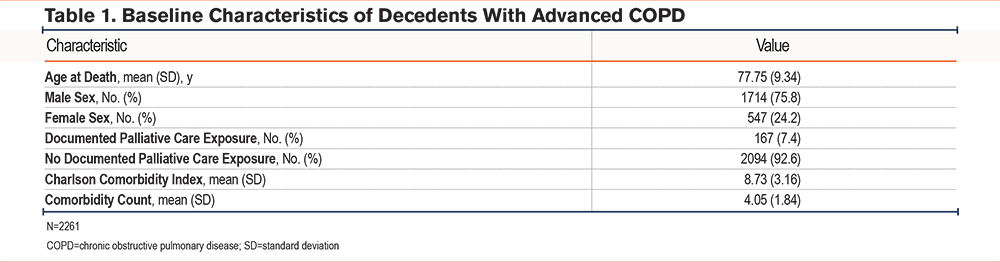
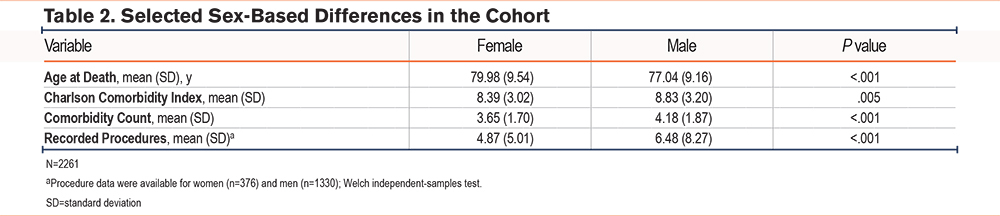
Overall clinical burden was high. Mean age-adjusted CCI was 8.73 (SD, 3.16), and mean comorbidity count was 4.05 (SD, 1.84). Women were older at death than men (79.98 [SD, 9.54] versus 77.04 [SD, 9.16] years; P<.001), whereas men had higher mean CCI scores (8.83 [SD, 3.20] versus 8.39 [SD, 3.02]; P=.005), higher comorbidity counts (4.18 [SD, 1.87] versus 3.65 [SD, 1.70]; P<.001), and higher recorded procedure counts among patients with procedure data (6.48 [SD, 8.27] versus 4.87 [SD, 5.01]; Welch P<.001) (Table 2).
Selected Comorbidities and Procedure Burden as a Proxy for Treatment Intensity
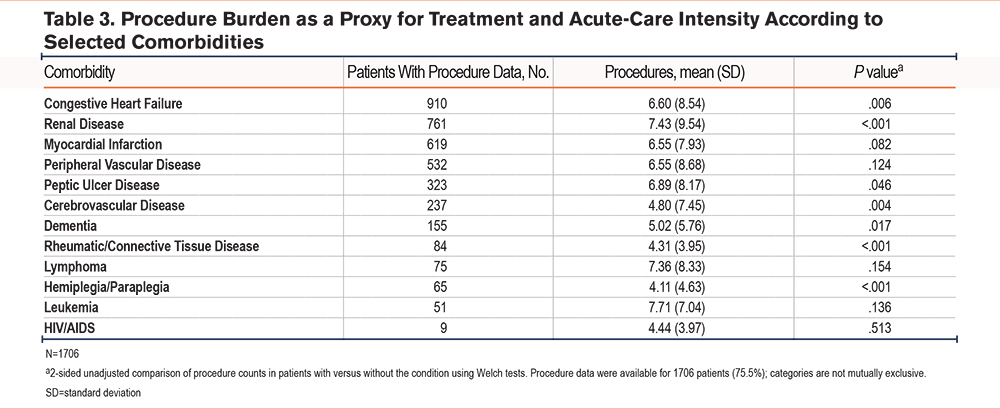
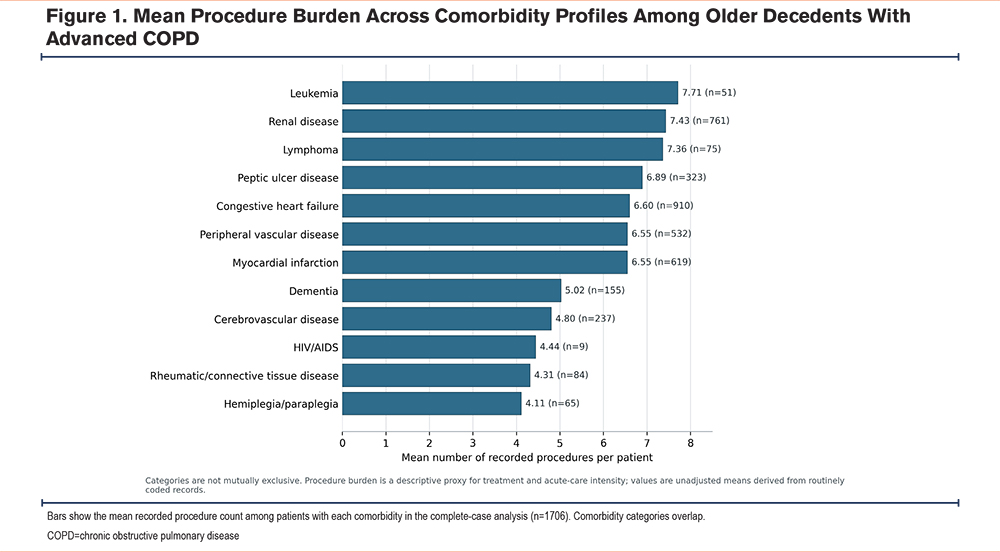
Procedure-count data were available for 1706 patients (75.5%); 555 (24.5%) had missing procedure data. Among complete cases, procedure burden, used as a pragmatic proxy for treatment and acute-care intensity, varied across overlapping comorbidity profiles. Mean counts were higher in patients with renal disease than in those without it (7.43 versus 5.06; Welch P<.001) and in those with congestive heart failure (6.60 versus 5.58; Welch P=.006). They were lower in patients with cerebrovascular disease (4.80 versus 6.33; Welch P=.004), dementia (5.02 versus 6.23; Welch P=.017), hemiplegia/paraplegia (4.11 versus 6.20; Welch P<.001), and rheumatic/connective tissue disease (4.31 versus 6.22; Welch P<.001). These exploratory, unadjusted comparisons do not isolate independent effects because comorbidities overlap and multiple tests were performed. The highest mean procedure counts among condition-present groups were recorded for leukemia (7.71 [SD, 7.04]), renal disease (7.43 [SD, 9.54]), and lymphoma (7.36 [SD, 8.33]) (Table 3 and Figure 1).
Acute-Care Utilization During the Last Year of Life
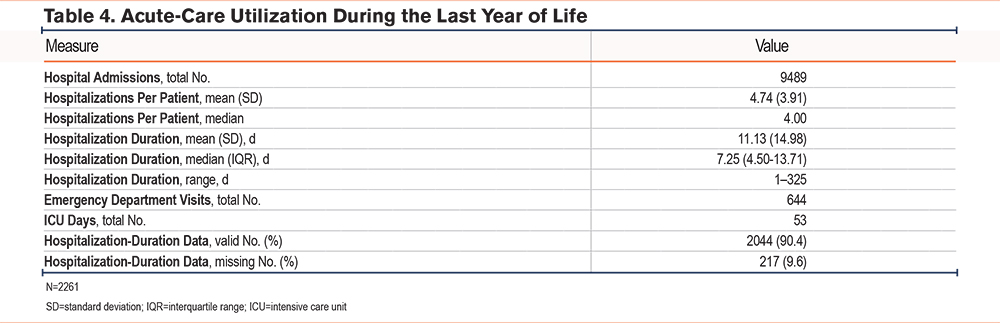
Health service use during the final year of life was substantial. A total of 9489 hospital admissions were recorded. The mean number of hospitalizations was 4.74 per patient (SD, 3.91), and the median was 4.00. Hospitalization-duration data were available for 2044 patients (90.4%); 217 observations (9.6%) were missing. Duration was right-skewed: the mean was 11.13 days (SD, 14.98), whereas the median was 7.25 days (IQR, 4.50–13.71; range, 1–325). The cohort also had 644 emergency department visits and 53 ICU days recorded (Table 4).
Discussion
This study shows that older decedents with advanced COPD had substantial multimorbidity and hospital-centered care during the final year of life, while documented palliative care exposure was uncommon (7.4%). The principal conclusions are supported by the descriptive findings and do not depend on survival comparisons. Accordingly, the Kaplan-Meier and Cox regression analyses were removed because the timing of palliative care exposure could not be reliably determined. Modeling this retrospectively identified exposure as a fixed variable would introduce a substantial risk of immortal-time bias and could misleadingly suggest a survival benefit associated with palliative care.
The multimorbidity burden observed in this cohort is consistent with earlier work showing that advanced COPD in older adults rarely exists as an isolated respiratory disorder.5-8 In practical terms, patients nearing the end of life with COPD are not simply managing airflow limitation. They are living with layered cardiovascular, renal, malignant, neurologic, and systemic conditions that alter both clinical needs and patterns of care. The mean CCI of 8.73 in this cohort emphasizes that advanced COPD near the end of life is better understood as a state of broad medical complexity rather than as single-organ failure alone.
The descriptive differences across comorbidity profiles reinforce the clinical heterogeneity of advanced COPD. Renal, cardiac, and hematologic conditions were accompanied by greater recorded procedure burden, whereas lower procedure counts among patients with dementia, cerebrovascular disease, and major neurologic disability may reflect greater frailty, different goals of care, lower expected benefit from repeated intervention, or coding differences. These findings show why comorbidity type, weighted burden, and unweighted condition count provide complementary rather than interchangeable information.7,8
Women were older at death, whereas men had higher mean age-adjusted CCI scores, comorbidity counts, and recorded procedure burden. Possible explanations include sex-related differences in lifetime tobacco and occupational exposure, COPD phenotype, cardiovascular and metabolic disease, health care use, and survival to older age. However, these mechanisms were not measured, women represented only 24.2% of the cohort, and procedure data were incomplete. The differences are, therefore, descriptive and hypothesis-generating rather than evidence of biological or causal mechanisms.10-12
The present findings also support distinguishing utilization burden from quality of care. High procedure counts and recurrent hospitalization do not necessarily indicate better care. In this study, procedure burden should be interpreted as a pragmatic proxy for treatment and acute-care intensity, while recognizing that it may also reflect documentation practices, coding granularity, and institutional recording patterns. In advanced COPD, procedural intensity may reflect crisis-driven management, multimorbidity-related instability, documentation practices, or repeated hospital-based evaluation. Conversely, palliative care exposure may not eliminate all acute-care use, especially in medically unstable patients, but it may signal that clinicians recognized broader supportive needs. This is another reason the palliative care finding is more informative as a trajectory marker than as a treatment-effect claim.
These findings also have implications for health-system design. International consensus criteria for specialist palliative care referral in COPD emphasize multidimensional need rather than a single prognostic threshold, including high health-service use or advanced respiratory therapies, severe symptom or psychosocial needs, decision-making needs, impaired performance status, and limited estimated prognosis.19 Recurrent hospitalization, multimorbidity, escalating symptoms, functional decline, and advanced respiratory support may, therefore, provide clinically useful triggers for palliative assessment. Recent evidence also identifies supplemental oxygen use as a readily available marker associated with higher hospital, ICU, and life-support use near the end of life, although oxygen data were unavailable in the present extract.20
Clinical and policy implications follow directly from these results. Older adults with advanced COPD should be assessed systematically for multimorbidity burden and not only respiratory severity. Specific comorbidities such as renal disease, hematologic malignancy, and neurologic disability may help identify patients at especially high risk. Repeated acute-care use should be recognized as a trigger for supportive and palliative assessment rather than accepted as the default trajectory of advanced COPD near the end of life. Because documented palliative care exposure may reflect coding and documentation as well as clinical care, health systems should improve the reliable recording of palliative involvement, referral timing, goals-of-care communication, and care content. Palliative care should be conceptualized less as a terminal add-on and more as part of a responsive care model to symptom burden, recurrent hospital utilization, and multidimensional complexity.
Limitations
This study has several limitations. Its retrospective design prevents causal inference. Documented palliative care exposure was uncommon and derived from routine records that did not reliably distinguish setting, referral, completed consultation, specialist involvement, intensity, or timing; underdocumentation and misclassification are, therefore, possible. We intentionally removed analyses comparing survival by palliative care exposure because the nontime-varying retrospective variable was vulnerable to immortal-time bias and could falsely suggest improved mortality in the exposed group.
The opioid-based inclusion criterion also limits generalizability. It was a pragmatic marker of treated symptom burden, but contemporary guidance does not support routine opioid use for breathlessness in serious respiratory illness, and the database did not record indication.21 The cohort may, therefore, overrepresent patients with pain, refractory symptoms, or greater contact with symptom-directed services and is not representative of all patients with advanced COPD. Lung cancer was excluded, but other causes of pain could not be excluded.
Administrative and routinely collected clinical data may introduce misclassification and variation related to coding practice. The FEV1 threshold identifies advanced airflow obstruction but does not by itself define end-stage COPD. Supplemental oxygen, frailty, functional status, symptom scores, smoking and occupational exposure, medication dose and indication, patient-reported outcomes, caregiver context, and quality of communication were unavailable. Bronchiectasis and emphysema were combined in the source extract despite their clinical differences and were not treated as a distinct prognostic construct. Procedure data were missing for 24.5% of the cohort, and procedure burden was a pragmatic indicator rather than a validated measure of care appropriateness. Comorbidity-specific comparisons were unadjusted, overlapping, and subject to multiple testing. Several utilization variables could not be stratified fully by comorbidity profile.
Conclusions
Older decedents with advanced COPD experienced substantial multimorbidity and heavy hospital-centered utilization during the final year of life, while documented palliative care exposure was uncommon. Men had higher recorded comorbidity and procedure burden, whereas women died at an older age; these descriptive differences require study with clinical, behavioral, and exposure data. The findings support earlier, complexity-based identification for supportive and palliative assessment when recurrent hospitalization, multidimensional symptoms, functional decline, or advanced respiratory support is present. They do not establish any effect of palliative care on mortality.
Acknowledgments
Author contributions: AnR conceived the study, led the study design, oversaw data interpretation, drafted the manuscript, and served as the main contributor to the work. AyR contributed to data interpretation, critical revision of the manuscript, and approval of the final version. AnR is the guarantor of the manuscript and takes responsibility for the integrity of the work as a whole.
Data sharing statement: The data that support the findings of this study were derived from Clalit Health Services and are not publicly available because of institutional and data protection restrictions. De-identified aggregate data may be available from the corresponding author upon reasonable request and with permission of Clalit Health Services and the relevant ethics authorities.
Other acknowledgements: The authors thank Clalit Health Services for support with data access and the secure research environment used for this study. The authors also acknowledge the clinical and administrative teams whose routine documentation made this retrospective analysis possible.
Generative artificial intelligence (OpenAI) was used solely to support English-language editing, including improvements in grammar, clarity, and readability. The authors reviewed and approved all revisions and take full responsibility for the accuracy, integrity, and final content of the manuscript. No generative AI tool was used to generate or analyze the study data.
Declaration of Interest
Authors declare no conflicts of interest relevant to this manuscript.