Running Head: FeNO and All-Cause Mortality
Funding Support: This work was supported by the Shenzhen Longgang District Science and Technology Innovation Bureau Medical and Health Technology Research Project (LGKCYLWS2023014); the National Natural Science Foundation of China [grant number 82371122]; and the National Natural Science Foundation of Guangdong Province [grant number 2022A1515012617].
Date of Acceptance: June 26, 2026 | Published Online Date: June 30, 2026
Abbreviations: ATS=American Thoracic Society; BMI=body mass index; CI=confidence interval; cNOS=constitutive nitric oxide synthase; COPD=chronic obstructive pulmonary disease; EOS=eosinophil; FEF25%–75%=forced expiratory flow rate 25%–75%; FeNO=fractional exhaled nitric oxide; FEV1=forced expiratory volume in 1 second; FEV3=forced expiratory volume in 3 seconds; FEV6=forced expiratory volume in 6 seconds; FVC=forced vital capacity; GOLD=Global initiative for chronic Obstructive Lung Disease; HR=hazard ratio; ln=natural logarithmic formation; NCHS=National Center for Health Statistics; NHANES=National Health and Nutrition Examination Survey; NO=nitric oxide; PEF=peak expiratory flow
Citation: Xiao S, Wen X, Qiu W, et al. Association of fractional exhaled nitric oxide with pulmonary health and all-cause mortality in a population without airflow limitation. Chronic Obstr Pulm Dis. 2026; 13(4): 328-339. doi: http://doi.org/10.15326/jcopdf.2025.0718
Introduction
Fractional exhaled nitric oxide (FeNO) is a biomarker of type 2 allergic inflammation chronic airway disease,1 particularly in patients with asthma.2 FeNO measurements can be used to select treatment agents, supervise the response to treatment, and assist with changes in therapy, such as in patients with allergic airway inflammation likely to respond to inhaled corticosteroid therapy and targeted biological agents.3-6 Additionally, FeNO could be beneficial for predicting the risk of future exacerbations,7-9 monitoring disease control,10 and evaluating compliance with oral glucocorticoids therapy in patients with asthma.8 Compared to other diagnostic and management modalities for asthma and chronic obstructive pulmonary disease (COPD), FeNO measurement has several advantages. For instance, it is a noninvasive test that can be performed quickly and easily.11
Previously, FeNO was thought to be a specific marker of eosinophilic airway inflammation, as mentioned in the 2011 American Thoracic Society (ATS) guidelines for the use of FeNO in clinical practice.1 Recently, COPD has been considered as a type 2 allergic inflammation chronic airway disease,12 and the inflammatory characteristics of some cases of COPD are similar to asthma, with elevated eosinophil and type 2 innate lymphoid cell counts.5 Various studies have reported FeNO as a predictor of prognosis in adults with asthma and COPD.1,2,13 Another study showed that simultaneous increases in FeNO and blood eosinophil count may be related to lung function decline and wheezing in patients with asthma.13 Moreover, a recent prospective cohort study showed that patients with COPD and high FeNO may be at an increased risk of exacerbation, hospitalization, and all-cause mortality compared to those with low FeNO.14 Therefore, FeNO may have practical implications for the management of airway inflammation in patients with COPD and asthma.
Fewer studies have assessed the association of FeNO with respiratory symptoms, lung function, and all cause-mortality in a healthy population. A large general Austrian population study previously found a significant positive relationship between forced expiratory volume in 1 second (FEV1)/forced vital capacity (FVC) and FeNO in children and adolescents.15 Therefore, the precise relationship of FeNO with pulmonary health and all-cause mortality in populations without airflow limitation remains uncertain. In this study, we aim to investigate the relationship of FeNO with respiratory symptoms, lung function, and all-cause mortality in a population without airflow limitation based on data from the National Health and Nutrition Examination Survey (NHANES).
Methods
Data Source
The NHANES is a comprehensive, multistage, and stratified sampling design survey that primarily aims to collect data on nutrition and health status from the U.S. population. All participants included in the NHANES underwent laboratory testing, physical examinations, and provided responses to surveys evaluating their health and dietary habits. Ethics approval for the NHANES was granted by the Review Board of the National Center for Health Statistics (NCHS), and prior to participation, all participants provided written informed consent.
Study Population
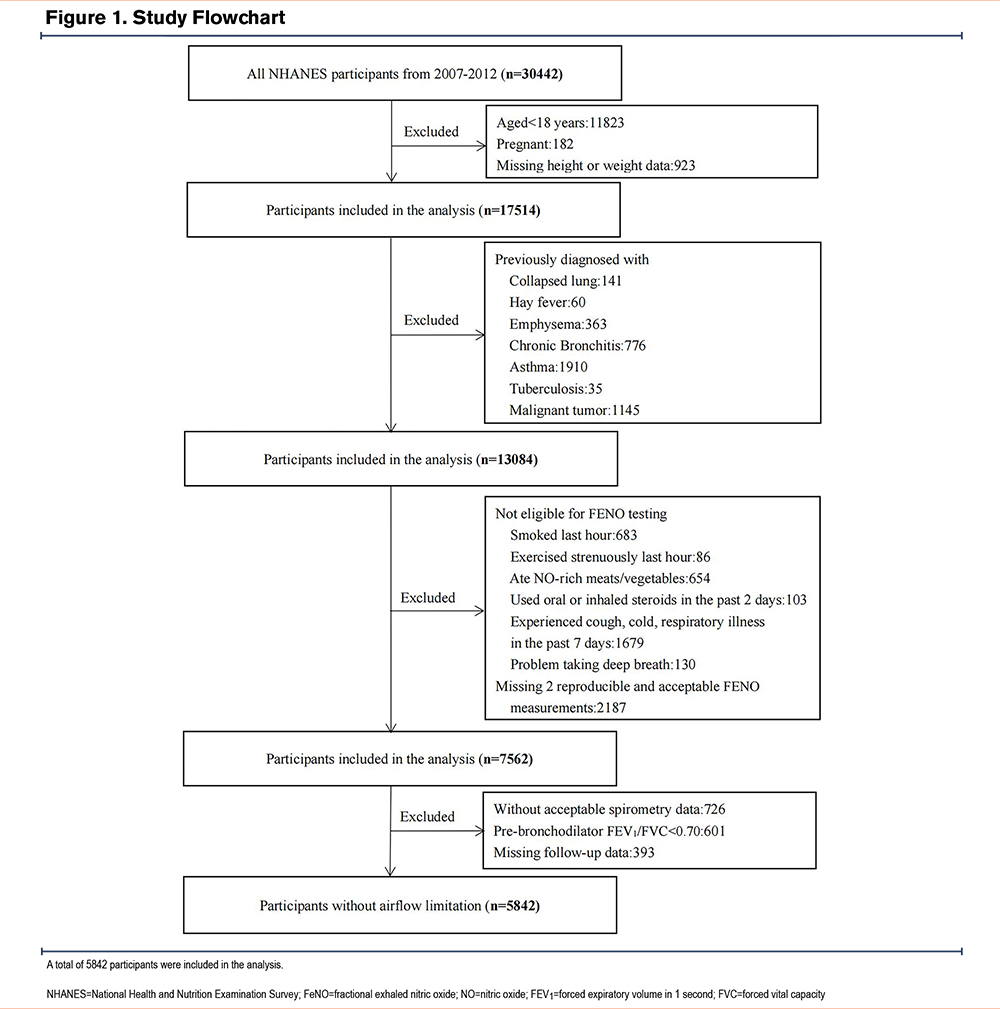
The data for the present study were sourced from 3 cycles of the NHANES spanning from 2007 to 2012, which involved a total of 30,442 participants. The participants were excluded from the present study if they met any of the following criteria:
- Aged <18 years;
- Identified as pregnant during the survey;
- Lacked fundamental questionnaire data, such as height or weight;
- Had been previously diagnosed with any of the following conditions: collapsed lung, hay fever, emphysema, chronic bronchitis, asthma, tuberculosis, or malignant tumor;
- Had engagement in any of the following behaviors before the FeNO examination: smoking or strenuous exercise in the last hour; consumption of nitric oxide (NO)-rich vegetables or meats; use of oral or inhaled steroids in the past 2 days; experienced cough, cold, or respiratory illness in the past 7 days; or had difficulty taking deep breaths;
- Lacked data for 2 replicable FeNO assessments meeting quality control standards;
- Lacked acceptable and quality-controlled prebronchodilator spirometry data;
- Had a prebronchodilator FEV1/FVC ratio of <0.70;
- Lacked follow-up data for mortality as of December 31, 2019.
Covariates
Covariates, including demographic characteristics (age, sex, race, body mass index [BMI], smoking status, poverty income ratio, occupational exposure, and comorbidities), were collected by personal interviews. Occupational history was assessed using the NHANES Occupation Questionnaire administered via computer-assisted personal interviews. Lifetime occupational exposures to mineral dusts, organic dusts, gases, fumes, and vapors were self-reported by participants aged 16–79 years. Current occupation and industry were coded using the U.S. Census Bureau's 2002 classification system by the National Institute for Occupational Safety and Health. Workplace tobacco smoke exposure was defined as self-reported exposure to tobacco smoke at the current job.
Definitions of COPD and Absence of Airflow Limitation
The Global initiative for chronic Obstructive Lung Disease (GOLD)16 criterion is a postbronchodilator spirometry FEV1/FVC ratio of <0.70. Most participants in the NHANES lacked data on postbronchodilator spirometry; thus, we diagnosed COPD based on prebronchodilator spirometry. We defined COPD as a prebronchodilator FEV1/FVC of <0.70 measured by spirometry. The absence of airflow limitation was defined as a prebronchodilator FEV1/FVC of ≥0.70 measured by spirometry. Asthma and chronic bronchitis diagnoses were obtained through questionnaires and self-reporting by the participants.
Assessment of Respiratory Symptoms and Medical History
We collected data on respiratory symptoms, notably chronic cough, chronic sputum, and wheezing. To assess the presence of chronic cough or sputum, we relied on the question, “Have you often experienced coughing or phlegm production for most days over a continuous period of 3 months or longer within the past year?” The presence of wheezing was determined by asking, “Have you experienced any instances of a whistling sound or wheezing in your chest in the previous 12 months?” Additionally, the participants’ medical histories were investigated, encompassing diagnoses made by health care professionals of conditions such as asthma, chronic bronchitis, emphysema, hay fever, collapsed lung, hypertension, coronary artery disease, diabetes mellitus, and other pertinent ailments. These assessments relied predominantly on self-reported data provided by the participants.
Spirometry
Spirometry was performed by skilled professionals using volume spirometers according to the procedures set forth by the ATS. Lung function assessment predominantly depended on the following parameters: FEV1, forced expiratory volume in 3 seconds (FEV3), forced expiratory volume in 6 seconds (FEV6), peak expiratory flow rate (PEF), FVC, forced expiratory flow rate 25%–75% (FEF25%–75%), and FEV1/FVC. FVC and FEV1 were converted to percentage predicted values using Hankinson’s predictive equation. This study exclusively included spirometry data that met the ATS quality grade ≥C. We defined airflow limitation based on a prebronchodilator FEV1/FVC of <0.70.
Fractional Exhaled Nitric Oxide Measurement
FeNO measurements were performed by trained professionals using a portable hand-held NO analyzer (Aerocrine AB; Solna, Sweden). The device’s detection range for exhaled values spanned from 5 to 300ppb. In cases where consecutive measurements fell below the device’s detection limit (5ppb), they were still considered valid, and a “fill” value of 3.5ppb was assigned. All included participants underwent 2 reproducible FeNO tests. Prior to the assessments, it was imperative to conduct detailed inquiries with the participants regarding behaviors or conditions that could potentially affect the FeNO assessment outcomes. This meticulous process was crucial due to the diverse array of factors known to influence the accuracy of FeNO measurements. For comprehensive information, please refer to the “participant exclusion criteria” section (Figure 1).
Outcomes
The primary outcome was all-cause mortality, with follow-up conducted until December 31, 2019. Participant survival or mortality status primarily relied upon data obtained from the National Death Index, which is linked with the NHANES by the NCHS.
Statistical Analysis
All datasets were analyzed using SPSS v.26 (IBM SPSS; Armonk, New York) and R, version 4.0.4 (R Project; Vienna, Austria). Categorical variables are expressed as case numbers (percentages), while continuous variables are expressed as means (95% confidence intervals [CIs]). The distribution of the participants’ FeNO levels is visually represented using histograms. Recognizing the skewed distribution of FeNO, natural logarithmic transformation (ln) was applied. Multivariate linear regression analysis was used to investigate the relationship between FeNO and participants’ pulmonary function indicators, while binary logistic regression analysis was used to explore the association between FeNO and respiratory symptoms. Additionally, we conducted a multivariate Cox proportional-hazards analysis to explore the relationship between FeNO and all-cause mortality, with trends graphically represented as smoothed curves. To clarify threshold effects and dose-response relationships, we constructed segmented linear regression models incorporating smoothing functions to determine the threshold effect of FeNO on all-cause mortality. After determining the cutoff value, subgroup analyses were performed by sex, age, BMI, smoking status, and blood eosinophil count to confirm the robustness of the study findings. Throughout all analyses, adjustments were made for confounding factors, including age, sex, BMI, race/ethnicity, smoking status, occupational exposure, hypertension, coronary heart disease, diabetes mellitus, prebronchodilator FEV1, and blood eosinophil count. All analyses were performed using 2-sided tests, and statistical significance was determined at a threshold of p<0.05.
Patient and Public Involvement
The design, conduct, reporting, and dissemination plans of this research did not involve the participation of patients and/or the public.
Results
Participant Characteristics
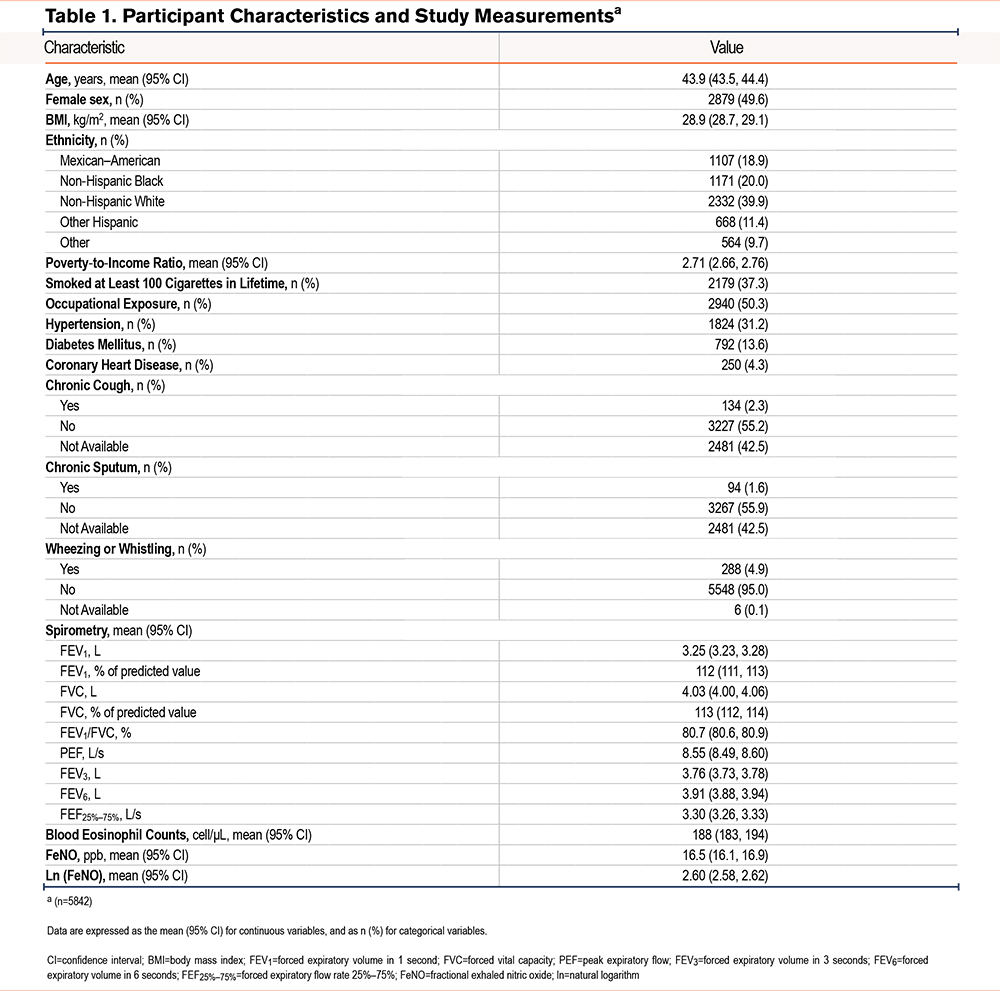
Overall, 5842 individuals were included in the analysis, with the detailed inclusion and exclusion processes outlined in Figure 1. The mean age of the participants was 43.9 (43.5, 44.4) years, with female individuals accounting for 49.6% of the population. The mean BMI was 28.9 (28.7, 29.1) kg/m2, and 37.3% of the participants self-reported a history of smoking >100 cigarettes in their lifetime. Furthermore, 50.3% of the participants self-reported occupational exposure. The mean blood eosinophil count was 188 (183, 194) cells/L. Comprehensive clinical characteristics are provided in Table 1.
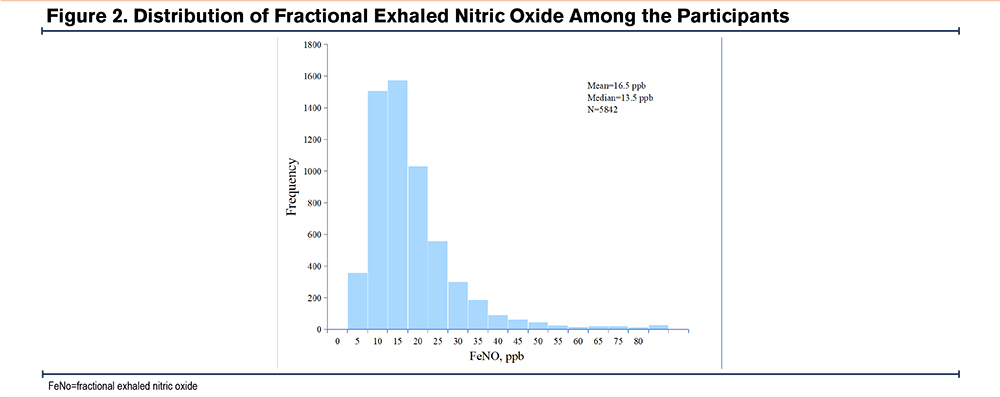
The participants exhibited a mean FeNO level of 16.5 (16.1, 16.9) ppb, with a median of 13.5 (9.0, 20.0) ppb. The distribution of FeNO levels (Figure 2) demonstrated skewness. Following natural logarithmic transformation of FeNO, the mean remained at 16.5 (16.1, 16.9) ppb.
Association of the Fractional Exhaled Nitric Oxide Level With Respiratory Symptoms and Lung Function
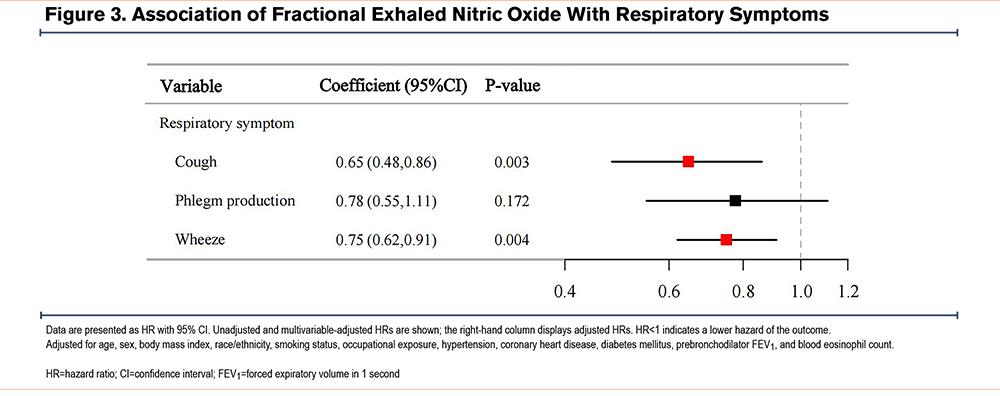
Self-reported respiratory symptoms, such as chronic cough and wheezing, were closely associated with the FeNO level. Even after adjusting for sex, age, BMI, smoking status, occupational exposure, hypertension, coronary heart disease, diabetes mellitus, prebronchodilator FEV1, and blood eosinophil count, a significant negative correlation persisted between the FeNO level and both chronic cough and wheezing. Specifically, for every 1 unit increase in ln (FeNO), the risk of chronic cough and wheezing decreased by 28% and 22%, respectively. However, there was no significant correlation between the FeNO level and chronic sputum (Figure 3).
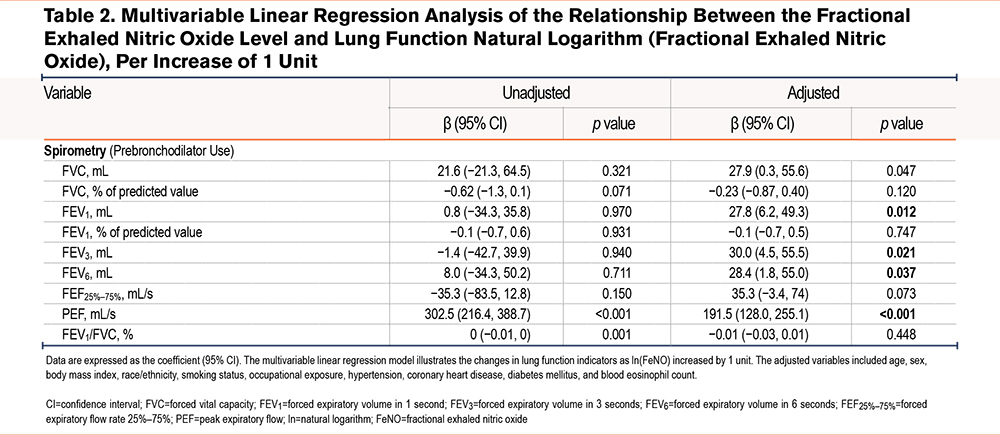
The mean FVC was 4.03L, while the mean FEV1 was 3.25L. FEV1 was 112% of the predicted value, with an FEV1/FVC ratio of 80.7%, and the mean PEF was 8.55L/s. Additionally, the mean FEV3 and FEV6 were 3.76L and 3.91L, respectively, and FEF25%–75% averaged 3.30L/s (Table 1). After adjusting for confounding variables, there was a significant correlation between a higher FeNO level and improved lung function among participants without airflow limitation. Specifically, for each 1-unit increase in ln (FeNO), there were respective mean increases of 27.9 (0.3, 55.6) mL in FVC, 27.8 (6.2, 49.3) mL in FEV1, 30.0 (4.5, 55.5) mL in FEV3, 28.4 (1.8, 55.0) mL in FEV6, and 191.5 (128.0, 255.1) mL/s in PEF. Detailed information is provided in Table 2.
Association Between the Fractional Exhaled Nitric Oxide Level and All-Cause Mortality
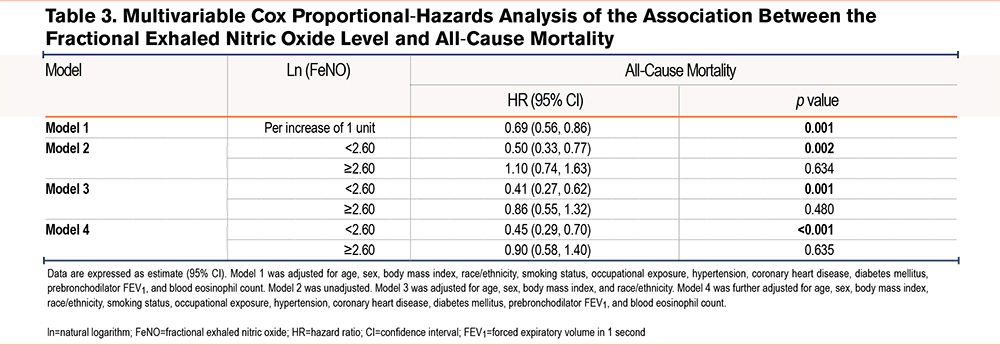
During the average follow-up period of 10 years, 255 participants (4.4%) experienced mortality. In our initial analysis by Cox regression, we evaluated the relationship between FeNO as a continuous variable and all-cause mortality. Our findings revealed a negative correlation, indicating that ln (FeNO) was associated with a reduced risk of all-cause mortality (hazard ratio [HR] 0.69, 95% CI 0.56, 0.86; p=0.001), as depicted in Model 1.
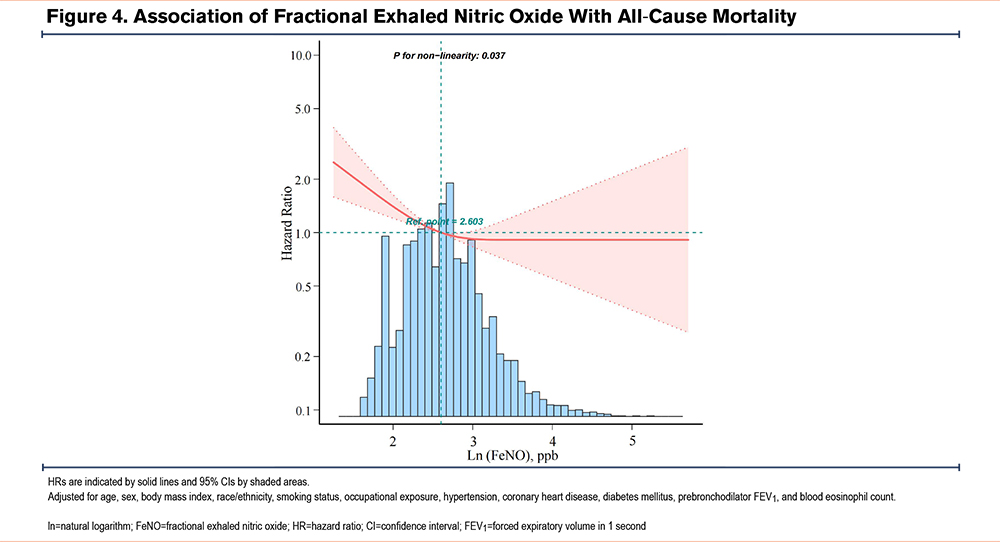
Using a Cox proportional-hazards regression model with restricted cubic splines and smoothed curve fitting, we investigated the relationship between the FeNO level and all-cause mortality. After adjusting for potential confounders (Figure 4), when ln (FeNO) was >2.6 (FeNO ≥ 13.5ppb), all-cause mortality remained relatively stable. However, when ln (FeNO) was <2.6 (FeNO<13.5ppb), a notable increase in the risk of all-cause mortality was observed as the FeNO level decreased (pnon-linearity<0.001).
In Table 3, we used the identified cutoff value for segmentation, we formulated 3 models to elucidate the relationship between the FeNO level and all-cause mortality. For the group with ln (FeNO) <2.6, the unadjusted HR for all-cause mortality was 0.50 (95% CI 0.33, 0.77; p=0.002) (Model 2). Following adjustment for baseline characteristics, the HR decreased to 0.41 (95% CI 0.27, 0.62; p=0.001) (Model 3). Further adjustment for comorbidities and clinical variables resulted in an adjusted HR of 0.45 (95% CI 0.29, 0.70; p<0.001) (Model 4).
Stratified Analyses
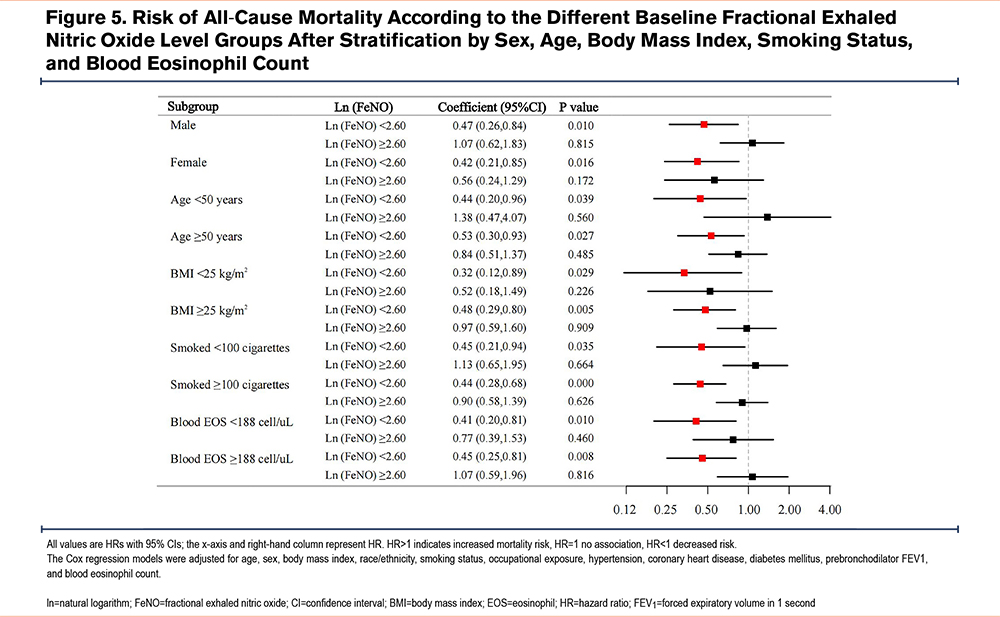
When the FeNO level was <13.5ppb, a significant increase in the risk of all-cause mortality occurred with a decrease in FeNO. Conversely, when the FeNO level was ≥13.5ppb, all-cause mortality remained relatively stable. This consistent pattern was observed across the subgroups stratified by sex, age, BMI, smoking status, and blood eosinophil count (Figure 5).
Discussion
The present study builds on past research by reporting the association of FeNO with lung function and all-cause mortality among individuals without airflow limitation. This study provides a new perspective suggesting that FeNO not only can be used for monitoring and managing patients with asthma and COPD, but also may be a useful biomarker for assessing general population health. The results demonstrate a significant positive association between the FeNO level and lung function parameters among individuals without airflow limitation. The findings suggest that a higher FeNO level indicates better lung function. Additionally, participants with FeNO< 13.5ppb exhibited a higher risk of all-cause mortality compared with those with higher FeNO levels. These results support the potential utility of FeNO as a biomarker for respiratory health and mortality risk assessment in individuals without airflow limitation.
Our findings are consistent with the study by Bal et al, who also reported that a higher FeNO level indicates better lung function in a healthy population.16 We suppose that the association of a higher FEV1/FVC and FeNO values in respiratory healthy participants likely reflects an increase in airway caliber, as reflected by the higher FEV1/FVC. FeNO depends on the airway caliber, residential status (urban versus rural), smoking status, body size, height, and total airway mucosa size.17-22 In participants without airflow obstruction, greater airway caliber increases total epithelial surface area available for constitutive nitric oxide production, providing a mechanistic basis for higher FeNO values in the absence of pathological eosinophilic inflammation.
Previous studies have established FeNO as a biomarker of type 2 inflammation in asthma and a predictor of exacerbations in COPD.23-28 However, these observations are derived from a population with obstructive disease and reflected inflammatory upregulation of inducible nitric oxide synthase. Such interpretations are not directly applicable to individuals without airflow limitation, in whom FeNO reflects homeostatic physiology rather than pathological inflammation.
NO is present in the exhaled breath of all humans and is produced by the lungs. The functions and effects of NO in the lungs/airways reflect its key roles as a vasodilator, bronchodilator, neurotransmitter, and inflammatory mediator.29 In the lungs, NO is produced by epithelial cells, vascular endothelial cells, and neurons.30 NO is also an important endogenous bronchodilator by inducing airway smooth muscle relaxation.30 Interestingly, NO is both proinflammatory and anti-inflammatory in the respiratory system.1 NO can also interact directly with high-energy free radicals, mitigating oxidative stress and the generation of proinflammatory lipids, thereby reducing inflammation.31 NO also enhances lung development, promotes ciliary motility, produces surfactant, and protects against bronchoconstriction.30,32 In T helper 2 allergic inflammation chronic airway disease, NO production is altered, leading to airway hyperresponsiveness. Animal studies have shown that after allergen exposure in asthmatic airways, there is a deficiency in NO production by constitutive nitric oxide synthase (cNOS), resulting in bronchoconstriction,33,34 and cNOS expression is downregulated, contributing to airway hyperresponsiveness.32
In the present study, one explanation for our findings is that at physiologically appropriate levels, NO supports airway smooth muscle relaxation, maintains larger airway caliber, and preserves mucosal homeostasis. In pathological conditions associated with obstructive disease, NO production is dysregulated. However, in our without airflow obstructive cohort, we observed a clear threshold pattern: mortality risk decreased significantly as FeNO increased up to 13.5ppb, after which the risk plateaued. Subgroup analyses confirmed the robustness of this pattern. This finding suggests that lower FeNO indicates reduced constitutive NO production, smaller airway caliber, and less favorable physiological status, thereby increasing mortality risk. Conversely, once FeNO reaches approximately 13.5ppb, additional NO does not confer further survival benefit, which may reflect a ceiling effect of NO-mediated homeostatic mechanisms.
Study Strengths and Limitations
This study has several notable strengths. First, to our knowledge, no cohort studies have evaluated FeNO as a predictor of mortality among people without airflow limitation. The present study revealed a strong nonlinear relationship between FeNO and mortality among individuals without airflow limitation. Second, the study was based on data from a population-based sample with follow-up data, standardized methods, and a large sample size. Finally, exhaled NO is influenced by several constitutional and environmental factors. Age, male sex, atopy, blood eosinophil count, and height may be related to the FeNO level.35-37 Consequently, we performed subgroup analyses stratified by sex, age, BMI, smoking status, and blood eosinophil count, and our results remained robust in the subgroup analyses.
Despite these important discoveries, our study also has limitations. First, asthma diagnosis was self-reported, as were asthma events and health care visits. The high prevalence of occupational exposure may be subject to the fact that the assessment of occupational exposure history relies on participants’ self-reports, leading to recall bias in the study. Second, the NHANES only performed postbronchodilator spirometry measurements in a limited number of individuals with airflow obstruction; therefore, we defined the absence of airflow limitation based on prebronchodilator spirometry measurements. A previous report demonstrated that postbronchodilator spirometry is a more accurate predictor of mortality than prebronchodilator spirometry, but they differ only by a small margin.38 Third, allergens are important factors affecting FeNO values.36 However, objective testing of allergic sensitization was not performed as part of the NHANES. Fourth, the study population was restricted to U.S. adults; therefore, whether our results are generalizable to other countries and regions remains to be clarified. Finally, the limitations of our study include the large number of participants with missing data for respiratory symptoms at baseline, which may raise the possibility of selection bias.
Conclusions
Elevated FeNO was associated with fewer respiratory symptoms, improved lung function, and all-cause mortality among individuals without airflow limitation. FeNO may be a useful biomarker for assessing lung function and mortality risk in this population. Further research is warranted to validate these findings and explore their clinical implications.
Acknowledgments
Author contributions: SX, XW, WQ, HY, NL, and YS had full access to all of the data in the study. CY takes responsibility for the integrity of the data and the accuracy of the data analysis. SX, XW, and YS were responsible for the concept and design. SX, XW, and YS contributed to the acquisition, analysis, or interpretation of data. SX, XW, and YS were responsible for the statistical analysis. SX, XW, and YS drafted the manuscript. SX was the study guarantor and takes responsibility for the integrity of the data and the accuracy of the data analysis. All authors contributed to the critical revision of the manuscript.
Availability of data and materials: All data used in this study is publicly available from the U.S. Centers for Disease Control and Prevention through the National Center for Health Statistics which manages the National Health and Nutrition Examination Survey.
Other acknowledgments: We thank all participants who volunteered as part of the National Health and Nutrition Examination Survey. We thank Emily Woodhouse, PhD, from Liwen Bianji (Edanz) (www.liwenbianji.cn) for editing the English text of a draft of this manuscript.
Declaration of Interest
The authors report no conflicts of interest. All authors have no relevant financial or non-financial competing interests to disclose.